The November 12, 2026 Microsoft 365 Outage


Introduction
Most users were unable to access their Exchange Online mailboxes through Outlook or other mail clients, and email delivery was delayed for many users, on November 12 and 13, 2026, according to Microsoft's preliminary Post Incident Report (PIR) for incidents EX1550543 and MO1550821. The PIR records the start at 16:20 UTC on November 12 and the end at 16:10 UTC on November 13 - 23 hours 50 minutes - and says the severity of impact varied by region, connection method and time. Parts of Copilot, Teams, SharePoint, OneDrive, Defender, Purview and other services that use Exchange Online were also affected.
Microsoft names three main factors behind the outage. A latent defect in a Windows fix prepared for its Microsoft 365 networking gateway servers surfaced when extra load from a Teams failover met reduced server capacity, and the failure then cascaded across the gateway fleet worldwide.
- Introduction
- Methodology and Coverage
- Timeline of the Outage
- Impact and Root Cause
- Confirmed Downstream Impacts
- Banking and Fintech
- CDN, DNS and Edge Infrastructure
- Cloud Providers
- Communication and Collaboration
- CRM, Marketing and Customer Support
- Crypto and Blockchain
- Cybersecurity
- Design
- Developer Tools
- Education Technology Platforms
- Educational Institutions
- Email Providers
- ERP and Business Systems
- Finance and Accounting
- Geospatial and Location Data
- HR and Workforce
- Identity and Access Management
- IoT and Consumer Hardware
- IT Operations and MSP Tools
- Legal
- LLMs and AI tools
- Logistics and Mobility
- Observability and Monitoring
- Payment Gateways
- Property and Facilities
- Telecom and ISP
- Voice, SMS and CPaaS
- Impact on Organizations Worldwide
- Earlier Microsoft 365 Outages
- What Microsoft Says Comes Next
- Conclusion
- FAQ
Methodology and Coverage
The sources used are listed below. These web pages, and other ones cited in the article, were fetched on November 16, 2026.
- Microsoft's preliminary PIR for EX1550543 and MO1550821, dated November 15, 2026, for the root cause, the internal timeline, the impact window and the repair items.
- Updates from Microsoft's public status page (status.cloud.microsoft), as recorded by IncidentHub, for the updates customers saw during the incident.
- Hacker News and EpiFive, for the Teams incident TM1550488.
Note: The PIR records the start at 16:20 UTC on November 12, when Microsoft received a high-priority alert and posted EX1550543 to the Service Health Dashboard. DMARCguard reported that Microsoft's final EX1550543 update gave the start as 10:05 UTC. The PIR does not mention 10:05 UTC. This post uses the PIR's times.
Timeline of the Outage
Rows without a source tag come from Microsoft's preliminary PIR. Rows tagged [IncidentHub] are updates on Microsoft's public status page as recorded by IncidentHub.
| UTC | Event |
|---|---|
| Nov 12 01:07 | Automated failover moved Teams traffic onto the network gateway front-end servers shared with Exchange Online. |
| 01:07 - 16:00 | Load on the front-end servers rose gradually. Isolated server failures began in some regions, and automated mitigations were applied. |
| 16:03 | The connectivity anomaly detection monitor picked up an increase in user connectivity issues. |
| 16:17 | Automation began redirecting traffic to other healthy endpoints. |
| 16:20 | Incident started. A high-priority alert for Exchange Online led Microsoft to post EX1550543 to the Service Health Dashboard. |
| 16:25 | Issues confirmed across multiple Exchange connection methods, including Outlook, Outlook on the web, Exchange ActiveSync, and the Messaging and REST APIs. |
| 16:33 | First support case received. User reports began building up on third-party sites such as Downdetector. |
| 17:32 | Automated redirection continued, but further degradation was detected across multiple regions. |
| 18:00 | Microsoft progressively restarted and tried to repair affected infrastructure, and worked to redirect traffic to other infrastructure. |
| 18:10 | [IncidentHub] First update on the public status page. Connectivity errors on part of the Exchange Online infrastructure that receives and processes access requests. |
| 18:27 | MO1550821 posted for other affected services, including Teams, Copilot and Defender. |
| 18:32 | [IncidentHub] The public status page widened the incident to multiple Microsoft 365 services and reported elevated load across multiple regions. |
| 19:00 | Response expanded. All ongoing and planned deployments and configuration changes were paused. |
| 19:20 | Microsoft determined that the elevated load was driven by many servers being unexpectedly unavailable, which was shifting load onto and overwhelming the remaining infrastructure. It was not driven by an overall increase in traffic. |
| 20:00 | A targeted change was deployed to bypass components found to be triggering failed health checks on affected servers. |
| 20:30 | Many affected servers were found unresponsive. Restarts started. |
| 21:00 | An alternative health check let a subset of servers return to service. |
| 22:00 | Microsoft confirmed its restore actions had not worked and broadened the scope of the investigation. |
| 23:55 | Servers returned to service stayed healthy at first, then became unresponsive again once they received traffic. |
| Nov 13 00:30 | Connection negotiation identified as the main area behind the access failures. |
| 01:06 | [IncidentHub] The public status page said Microsoft had begun reverting "a recent network configuration change that correlates with the start of impact". |
| 01:53 | Some automated traffic redirection by the anomaly detection monitors was disabled. |
| 04:00 | Traffic adjustments brought partial recovery in some regions, but it did not hold. |
| 04:11 | [IncidentHub] The public status page said there was "no indication this is the result of malicious activity". |
| 05:00 | Machines stuck in bad states kept changes from syncing as expected. Microsoft scaled up virtual machines. |
| 07:20 | Mitigation applied to part of the capacity - an update that reverted the defective change. |
| 08:00 | Server stability confirmed on updated infrastructure. Rollout prioritized regions in or entering peak business hours. |
| 09:10 | [IncidentHub] The public status page said Microsoft was extending the email timeout window to 48 hours to help protect delayed messages. |
| 11:00 | Recovery actions completed across portions of the affected infrastructure in the Asia Pacific region. |
| 11:35 | Availability in Europe returned to healthy levels. |
| 13:00 | Recovery progress held across all regions. Queues of delayed email began to shrink. |
| 14:17 | Global webmail availability returned to expected levels, and was still stable at 14:44. |
| 15:54 | Most major access methods were back to normal traffic levels. |
| 16:10 | Incident ended. No active customer impact. Microsoft moved into extended monitoring and backlog recovery. |
| 17:57 | [IncidentHub] The public status page posted an apology and the preliminary cause. |
| Nov 14 04:15 | Final customer updates posted to EX1550543 and MO1550821. |
| 05:45 | [IncidentHub] The incident was marked resolved on the public status page. |
Impact window (Microsoft preliminary PIR): 16:20 UTC on November 12 to 16:10 UTC on November 13, 2026, 23 h 50 m.
The thing to note here is that the first update on Microsoft's public status page, as recorded by IncidentHub, came at 18:10 UTC, 1 hour 50 minutes after the PIR's start, whereas the PIR says EX1550543 was posted to the Service Health Dashboard at 16:20 UTC.
Microsoft also posted a Teams incident, TM1550488, for users in North America on November 12, according to its advisory as quoted on Hacker News. EpiFive, citing BleepingComputer, describes it as a separate, earlier Teams incident that ran from 9:45 to 10:53 a.m. ET (14:45 to 15:53 UTC), and says Microsoft has not said whether the two are related. The PIR does not mention it.
Impact and Root Cause
The preliminary PIR says the information in it is subject to change, and that a final PIR will supersede it.
Preliminary Root Cause
Microsoft names three main factors that together took down the networking gateway that sits in front of many Microsoft 365 services.
The first was a latent defect. Under certain load, lock contention inside an internal Windows process exhausted the CPU and memory of a server, which then stopped responding. The defect came from a fix that Microsoft made for these gateway servers in particular.
"This defect was the result of a fix that was prepared specifically for Microsoft 365 networking gateway servers; neither the underlying defect nor the fix applies to broader Windows deployments."
The change began rolling out in July, went through safe deployment over several weeks, and ran worldwide for more than three months without impact. Microsoft says its normal load testing did not detect the defect because of the traffic mix and SKUs used in its labs. The contention is worse on newer hardware with more cores, whereas its load testing tended to focus on weaker hardware with fewer cores.
The second was extra load. Microsoft runs two independent network gateway systems, designed for isolation and high availability, which allow many Microsoft 365 services to fail over between them. At 01:07 UTC on November 12, about 15 hours before the outage, Teams failed over from the alternative gateway to the "primary" gateway that also serves Exchange Online. This raised the load on that gateway and changed its traffic patterns. Microsoft describes this type of failover as part of normal operations.
The third was reduced capacity. Nearly 14% of the gateway's server capacity was out of service because of an unrelated issue from the previous day. Microsoft says there was enough headroom that this had no impact on its own.
During the incident, the public status page update recorded by IncidentHub at 01:06 UTC on November 13 said Microsoft had begun reverting a recent network configuration change that correlated with the start of impact. The update recorded at 17:57 UTC said the incident "was introduced by an issue during an earlier network capacity upgrade that surfaced following a recent network change". The preliminary PIR does not mention that network configuration change or a network capacity upgrade.
Increased Load Leading to a Cascading Effect
Higher load on fewer servers triggered the defect during peak traffic hours in the United States. Microsoft's traffic management then did what it normally does and moved users from the failed servers to healthy ones. Those servers received more load and hit the same defect.
"In less than two hours, the previously unknown defect was encountered across our fleet and rendered them unresponsive."
At the lowest point, more than 80% of the gateway servers were unresponsive. The gateway is divided into thousands of "capacity units" grouped into regions, with normal bulkheads between these partitions. Microsoft says that, due to a separate issue, those bulkheads did not stop the cascading failure, and that this allowed the impact to spread across the gateway infrastructure globally. The PIR does not describe that separate issue.
What Customers Experienced
According to the PIR, the main impact was on Exchange Online, where most users could not reach their mailboxes through Outlook or other mail clients, and email delivery was delayed for many users. Other services that use Exchange Online were also affected, though Microsoft says most of them largely stayed online. Severity varied by region, connection method and time, and users may have had partial or intermittent access while the service was degraded.
Teams, OneDrive, SharePoint and the Office apps were able to fail out of the affected gateway. This is why they partly recovered earlier, and Teams chats and meetings worked for most of the outage. Exchange Online cannot fail out of this gateway "for scale reasons", according to the PIR. In the public status page update recorded by IncidentHub at 09:10 UTC on November 13, Microsoft said most core Teams functionality, including joining calls, meetings, group chats and channel messages, was not impacted. That update listed failures with calendar and scheduling, Live and Virtual event creation, and adding or syncing contacts, and said users might be unable to create or delete private or shared channels.
Services Affected
The PIR lists the services impacted as Microsoft 365 services including Exchange, Copilot, Teams, SharePoint, OneDrive, Defender, Purview, Fabric, Intune, Planner, Power Apps, To Do, Power BI and Universal Print.
The list in the public status page update recorded by IncidentHub at 09:10 UTC on November 13 is slightly different. It also named the Microsoft 365 admin center, Microsoft 365 apps, the Microsoft 365 Apps Admin Center, Microsoft 365 Education, Microsoft Graph and Windows 365 Cloud PCs that use Microsoft Purview Customer Key. It did not name OneDrive, which the PIR does.
Recovery
Microsoft says recovery took longer than usual because servers that came back were immediately swamped by waiting traffic and failed again. Its automated recovery was not designed to bring the service back from such a broad unresponsive state. Because the defect came from a change made months earlier, its usual rollback, "flighting" and feature flags could not quickly revert it.
Large distributed systems often suffer from secondary outages during recovery due to thundering herd and backed up queues. Previous outages like the one in AWS in October 2025 and Trigger.dev in June 2026 had similar patterns.
Once engineers confirmed the defect as the cause, Microsoft built an update that returned the code path to its previous known good state in Windows. It applied the update by taking groups of servers out of service, updating and restarting them, and returning them to service, in large batches such as 50% or more of a region at a time. The first part of the capacity got the update at 07:20 UTC on November 13, 15 hours after the start. Recovery actions were completed across portions of the affected infrastructure in Asia Pacific at 11:00 UTC, availability in Europe returned to healthy levels at 11:35 UTC, and Microsoft confirmed no active customer impact at 16:10 UTC.
Email Delivery During the Outage
SparkPost published three replies it received from Microsoft's SMTP servers during the incident, and all three were temporary 4xx SMTP codes, which tell the sending server to keep the message queued and retry it. DMARCguard lists Mailgun's default retry window as 8 hours, and quotes Mailgun saying that some messages may have expired with status code 602, and that those messages were not delivered and will need to be retried.
Microsoft's public status page update recorded by IncidentHub at 09:10 UTC on November 13 said it was extending the email timeout window to 48 hours. The PIR lists the extended email delivery window as a completed repair item, meant to ensure that delayed messages were not returned as undeliverable and that all messages queued during the event were processed.
Confirmed Downstream Impacts
IncidentHub recorded 138 confirmed downstream providers which had outages and named the Microsoft 365 outage as a cause. Multiple services were affected in some providers.
Banking and Fintech
| Service | Incident URL |
|---|---|
| MeridianLink | Status page/Outage URL |
CDN, DNS and Edge Infrastructure
| Service | Incident URL |
|---|---|
| Akamai | Status page/Outage URL |
| F5 | Status page/Outage URL |
| GoDaddy | Status page/Outage URL |
Cloud Providers
| Service | Incident URL |
|---|---|
| Broadcom | Status page/Outage URL |
| Dogado | Status page/Outage URL |
| Fasthosts | Status page/Outage URL |
| Host Europe | Status page/Outage URL |
| HostPapa | Status page/Outage URL |
| Ionos | Status page/Outage URL |
| Netlify | Status page/Outage URL |
| OIT Services | Status page/Outage URL |
| One.com | Status page/Outage URL |
| Scaleway | Status page/Outage URL |
Communication and Collaboration
| Service | Incident URL |
|---|---|
| Access4 | Status page/Outage URL |
| AnywhereNow | Status page/Outage URL |
| Asana | Status page/Outage URL |
| Atlassian Jira Service Management | Status page/Outage URL |
| Crossware | Status page/Outage URL |
| LoopUp | Status page/Outage URL |
| monday.com | Status page/Outage URL |
| Notion | Status page/Outage URL |
| SavvyCal | Status page/Outage URL |
| Superhuman | Status page/Outage URL |
| Vonage Contact Center | Status page/Outage URL |
| Zoom | Status page/Outage URL |
CRM, Marketing and Customer Support
| Service | Incident URL |
|---|---|
| Amplience | Status page/Outage URL |
| Awin | Status page/Outage URL |
| beehiiv | Status page/Outage URL |
| Brevo | Status page/Outage URL |
| Deskpro | Status page/Outage URL |
| Fin (AU Hosting) | Status page/Outage URL |
| Fin (EU Hosting) | Status page/Outage URL |
| Fin (US Hosting) | Status page/Outage URL |
| Freshservice | Status page/Outage URL |
| Freshworks CRM | Status page/Outage URL |
| HappyFox | Status page/Outage URL |
| HubSpot | Status page/Outage URL |
| Mailchimp | Status page/Outage URL |
| Optimizely | Status page/Outage URL |
| Qualified | Status page/Outage URL |
| Qualtrics | Status page/Outage URL |
| SuperOffice | Status page/Outage URL |
| Teamleader | Status page/Outage URL |
| Zendesk | Status page/Outage URL |
Crypto and Blockchain
| Service | Incident URL |
|---|---|
| LMAX | Status page/Outage URL |
Cybersecurity
| Service | Incident URL |
|---|---|
| Abnormal | Status page/Outage URL |
| Barracuda Networks | Status page/Outage URL |
| Bitdefender GravityZone | Status page/Outage URL |
| EasyDMARC | Status page/Outage URL |
| ESET | Status page/Outage URL |
| Expel | Status page/Outage URL |
| Hornet Security | Status page/Outage URL |
| HoxHunt | Status page/Outage URL |
| Huntress | Status page/Outage URL |
| KnowBe4 | Status page/Outage URL |
| Mesh Security | Status page/Outage URL |
| Mimecast | Status page/Outage URL |
| Nucleus Security | Status page/Outage URL |
| OPSWAT | Status page/Outage URL |
| Securly | Status page/Outage URL |
| Sophos | Status page/Outage URL |
| Vipre | Status page/Outage URL |
Design
| Service | Incident URL |
|---|---|
| Adobe | Status page/Outage URL |
| Autodesk | Status page/Outage URL |
| Bentley Systems | Status page/Outage URL |
Developer Tools
| Service | Incident URL |
|---|---|
| Atlassian Jira | Status page/Outage URL |
| MindTickle | Status page/Outage URL |
Education Technology Platforms
| Service | Incident URL |
|---|---|
| AARNet | Status page/Outage URL |
| Digistorm | Status page/Outage URL |
| Great Minds | Status page/Outage URL |
| Network for Learning (N4L) | Status page/Outage URL |
Educational Institutions
| Service | Incident URL |
|---|---|
| Athabasca University | Status page/Outage URL |
| MIT IT Systems | Status page/Outage URL |
Email Providers
| Service | Incident URL |
|---|---|
| Sinch Mailgun | Status page/Outage URL |
| SMTP2GO | Status page/Outage URL |
| SparkPost | Status page/Outage URL |
ERP and Business Systems
| Service | Incident URL |
|---|---|
| Exact | Status page/Outage URL |
| OpenText | Status page/Outage URL |
Finance and Accounting
| Service | Incident URL |
|---|---|
| Expensya | Status page/Outage URL |
| Morningstar | Status page/Outage URL |
| MYOB | Status page/Outage URL |
| Xero | Status page/Outage URL |
Geospatial and Location Data
| Service | Incident URL |
|---|---|
| Cirium | Status page/Outage URL |
HR and Workforce
| Service | Incident URL |
|---|---|
| Ashby | Status page/Outage URL |
| Rippling | Status page/Outage URL |
Identity and Access Management
| Service | Incident URL |
|---|---|
| HENNGE One | Status page/Outage URL |
IoT and Consumer Hardware
| Service | Incident URL |
|---|---|
| Axis Communications | Status page/Outage URL |
IT Operations and MSP Tools
| Service | Incident URL |
|---|---|
| Arcserve | Status page/Outage URL |
| Commvault Cloud (Metallic) M1 | Status page/Outage URL |
| Commvault Cloud (Metallic) M100 | Status page/Outage URL |
| Commvault Cloud (Metallic) M101 | Status page/Outage URL |
| Commvault Cloud (Metallic) M102 | Status page/Outage URL |
| Commvault Cloud (Metallic) M103 | Status page/Outage URL |
| Commvault Cloud (Metallic) M104 | Status page/Outage URL |
| Commvault Cloud (Metallic) M105 | Status page/Outage URL |
| Commvault Cloud (Metallic) M106 | Status page/Outage URL |
| Commvault Cloud (Metallic) M107 | Status page/Outage URL |
| Commvault Cloud (Metallic) M108 | Status page/Outage URL |
| Commvault Cloud (Metallic) M109 | Status page/Outage URL |
| Commvault Cloud (Metallic) M111 | Status page/Outage URL |
| Commvault Cloud (Metallic) M112 | Status page/Outage URL |
| Commvault Cloud (Metallic) M113 | Status page/Outage URL |
| Commvault Cloud (Metallic) M116 | Status page/Outage URL |
| Commvault Cloud (Metallic) M2 | Status page/Outage URL |
| Commvault Cloud (Metallic) M3 | Status page/Outage URL |
| Commvault Cloud (Metallic) M301 | Status page/Outage URL |
| Commvault Cloud (Metallic) M4 | Status page/Outage URL |
| ConnectWise | Status page/Outage URL |
| Domotz | Status page/Outage URL |
| Envoy | Status page/Outage URL |
| Kaseya | Status page/Outage URL |
| Mintra | Status page/Outage URL |
| N-able | Status page/Outage URL |
| PDQ | Status page/Outage URL |
| Sherweb | Status page/Outage URL |
| Veeam | Status page/Outage URL |
Legal
| Service | Incident URL |
|---|---|
| Docusign | Status page/Outage URL |
| SurePoint | Status page/Outage URL |
LLMs and AI tools
| Service | Incident URL |
|---|---|
| Anthropic | Status page/Outage URL |
| OpenAI | Status page/Outage URL |
Logistics and Mobility
| Service | Incident URL |
|---|---|
| Entur | Status page/Outage URL |
Observability and Monitoring
| Service | Incident URL |
|---|---|
| Dynatrace | Status page/Outage URL |
| Splunk Observability EU0 | Status page/Outage URL |
| Splunk Observability US0 | Status page/Outage URL |
| Splunk Observability US1 | Status page/Outage URL |
| Splunk Observability US2 | Status page/Outage URL |
Payment Gateways
| Service | Incident URL |
|---|---|
| Chargebee | Status page/Outage URL |
| Klarna | Status page/Outage URL |
| Nets Easy | Status page/Outage URL |
| Nets Netaxept | Status page/Outage URL |
| Paysafe | Status page/Outage URL |
| Worldpay | Status page/Outage URL |
Property and Facilities
| Service | Incident URL |
|---|---|
| Mews | Status page/Outage URL |
Telecom and ISP
| Service | Incident URL |
|---|---|
| Voyager NZ | Status page/Outage URL |
Voice, SMS and CPaaS
| Service | Incident URL |
|---|---|
| Mitto | Status page/Outage URL |
| Telnyx | Status page/Outage URL |
| Twilio | Status page/Outage URL |
Impact on Organizations Worldwide
Downdetector had logged more than 131,000 Outlook reports at the highest point reported by TechRadar, and reports came from 74 countries and territories within about an hour, according to Al Jazeera. Microsoft has not given a count of affected users.
Al Jazeera reported disruption to government systems in Singapore and Japan, to communications at the Supreme Court of the Philippines, and to Australia's spy agency and federal police. In the UK, Hertfordshire and Dorset Police asked people to call 101 for reports that were time-critical but not an emergency, according to TechRadar. Forbes reported that IndiGo and Akasa Air had disruption to customer support email and that Air India temporarily rerouted email. Forbes also reported that OpenAI said new connections to Microsoft's services might fail and existing tools might not work as expected, and that Anthropic said email, calendar and search tools in its Microsoft 365 connector were failing for most requests. Tom's Hardware reported that Richemont delayed its earnings report and that some Japanese workers went back to fax machines.
At the Phantasialand theme park in Brühl, Germany, 15 people were injured at the pool of Hotel Ling Bao on November 13 after a faulty dosing system put too much chlorine in the water. Four were taken to hospital, according to t-online and Blick. The park told the broadcaster WDR that its warning systems had raised the alarm, but because of the Microsoft outage the people responsible did not learn of it, according to t-online. Blick reports that the dosing system sent warnings about chlorine levels only by email, and that the Outlook outage stopped them from arriving.
Earlier Microsoft 365 Outages
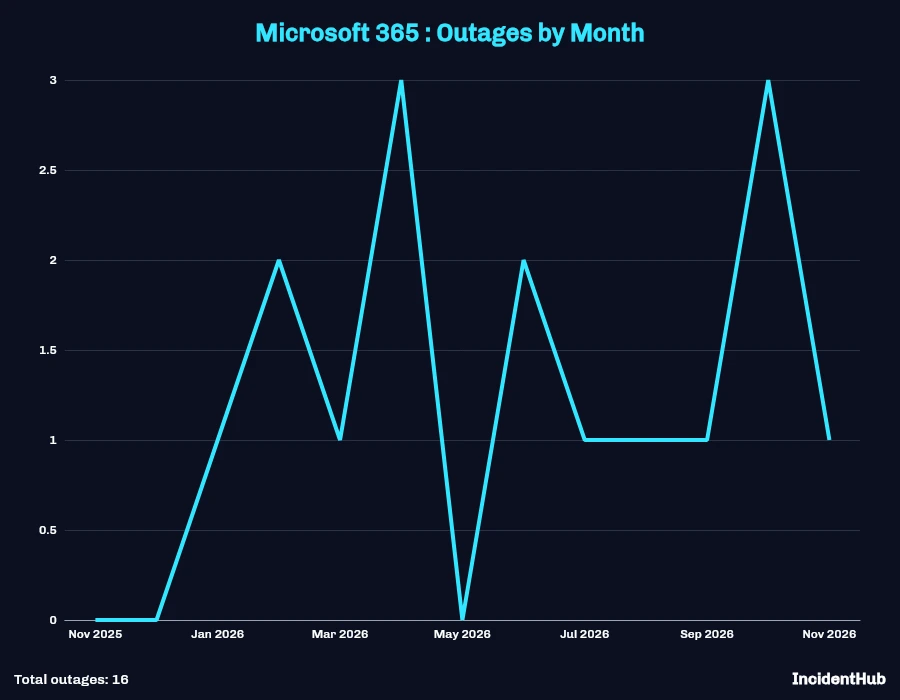
Between November 1, 2025 and November 17, 2026, IncidentHub recorded 16 Microsoft 365 outages, including this one.
October 13, 2026 - Microsoft 365 Global Secure Access
Users who reached Microsoft 365 through Global Secure Access had trouble with Outlook, OneDrive, SharePoint Online, Teams and Windows 365 Cloud PCs, among other services, from 07:40 UTC to 18:31 UTC on October 13, 2026 - about 10 hours 51 minutes. Updates before 17:26 UTC gave the start as 08:00 UTC. Microsoft listed the impact for Germany and the United Kingdom until its 17:26 UTC update, and for Germany only after that. Mid-incident updates said a section of GSA infrastructure was performing below acceptable performance thresholds. The updates did not say Microsoft 365 was unavailable for users who were not using Global Secure Access.
January 22, 2026 - Microsoft 365 in North America
Microsoft 365 services in North America, including Outlook, Defender and Purview, were disrupted for about 10 hours starting on January 22, 2026, according to The Register. Microsoft acknowledged the problem at 19:37 UTC and reported access restored at 05:33 UTC on January 23. It blamed a portion of its service infrastructure in North America that was not processing traffic as expected.
What Microsoft Says Comes Next
The preliminary PIR lists these repair items as completed:
- An update that returned the connection handling code path to its previous known good state.
- An extended email delivery window, meant to ensure that delayed messages were not returned as undeliverable.
- Additional capacity, added as a proactive measure to help with recovery.
- Additional monitoring for traffic redirection patterns and connection handling health.
- Guardrails for traffic distribution to avoid cascading impact.
Microsoft says a comprehensive list of repair items will be delivered in the final PIR, with a date of November 20, 2026, and that many longer-term changes from its full root cause analysis will be in that report.
Conclusion
Exchange Online, and parts of the Microsoft 365 services that depend on it, were disrupted worldwide from 16:20 UTC on November 12 to 16:10 UTC on November 13, 2026 - 23 hours 50 minutes according to Microsoft's preliminary PIR. Microsoft attributes the outage to a latent defect in a Windows fix for its networking gateway servers, first deployed in July, which surfaced when a Teams failover added load and nearly 14% of server capacity was already out of service. Traffic moving from failed servers to healthy ones then spread the failure across the fleet. The preliminary report gives November 20, 2026 for the final PIR's full list of repair items.
FAQ
How long did the November 12, 2026 Microsoft 365 outage last?
23 hours 50 minutes according to Microsoft's preliminary PIR, from 16:20 UTC on November 12 to 16:10 UTC on November 13, 2026. Microsoft kept monitoring after that and posted its final customer updates at 04:15 UTC on November 14.
What caused the November 12, 2026 Microsoft 365 outage?
A latent defect in a Windows fix made for Microsoft 365 networking gateway servers, according to Microsoft's preliminary PIR. Lock contention in an internal Windows process exhausted server CPU and memory under load. Extra load from a Teams failover and nearly 14% of capacity being out of service triggered it, and traffic moving between servers spread it across the fleet.
Which regions were affected by the November 12, 2026 Microsoft 365 outage?
Worldwide. The PIR describes a global outage of the networking gateway, with more than 80% of its servers unresponsive at the lowest point, and says the severity of impact varied by region.
Was there a workaround for the November 12, 2026 Microsoft 365 outage?
Not for mailbox access, in the status page updates recorded by IncidentHub. The only workaround in those updates was for Microsoft Fabric users whose exports, updates or Power BI Desktop files failed on items with sensitivity labels, which was to remove the label from the affected item if the organization's data protection policies allowed it.
Did other companies report impact from this incident?
Yes. IncidentHub recorded 138 confirmed downstream providers that had outages which named the Microsoft 365 outage as a cause.
Was it a cyberattack?
No. Microsoft's public status page update recorded by IncidentHub at 17:57 UTC on November 13 described it as "a technical issue not related to cyber or AI / agents", and the PIR attributes it to a latent software defect combined with extra load and reduced capacity.
IncidentHub is not affiliated with any of the services and vendors mentioned in this article. All logos and company names are trademarks or registered trademarks of their respective holders. This summary is independent and not affiliated with or endorsed by Microsoft or any of the services and vendors mentioned in this article.
This article was first published on the IncidentHub blog.
You might also like: