Six IsDown Alternatives in 2026


Introduction
IncidentHub tracked 30,246 outages across 1,082 providers between January and June 2026. Dependency risk is a major factor when your business depends on third-party services. A vendor outage monitor and status page aggregator can help you stay on top of which vendors are down, and which are up.
UptimeRobot announced in July 2026 that it had acquired the status page aggregator IsDown. IsDown's own announcement had said earlier that the product, name, team, and prices would stay the same, with billing moving to UptimeRobot. If you are looking at other options, here is a list of some tools that do the same job.
Sites like Downdetector work differently, using reports from users rather than official status pages, so they aren't in this list.
Every feature and plan below was taken from each product's own website on September 21, 2026, named in each section. Products change, so please check the named sites before you decide.
- Introduction
- How This List Was Created
- What is IsDown
- IsDown Alternatives
- Mistakes to Avoid When Switching from IsDown
- Choosing by catalog size
- Not writing down your current setup
- Checking integrations on the website instead of on your plan
- Forgetting outages that never reach public status pages
- Not deciding how much history you need
- Forgetting custom integrations
- Turning everything on at once
- Switching before the new tool has seen a real incident
- Forgetting your status pages
- Conclusion
- FAQ
How This List Was Created
We looked at tools that watch official vendor status pages, and either send alerts or display the overall status on a unified status page, or both. The feature lists come from each tool's own website. Each tool has a screenshot where applicable, captured on September 21, 2026.
What is IsDown
IsDown watches the status pages of other companies' services and alerts you when one of them has an outage. It tracks 6,320+ vendors. Since June 2026 it has been owned by UptimeRobot.
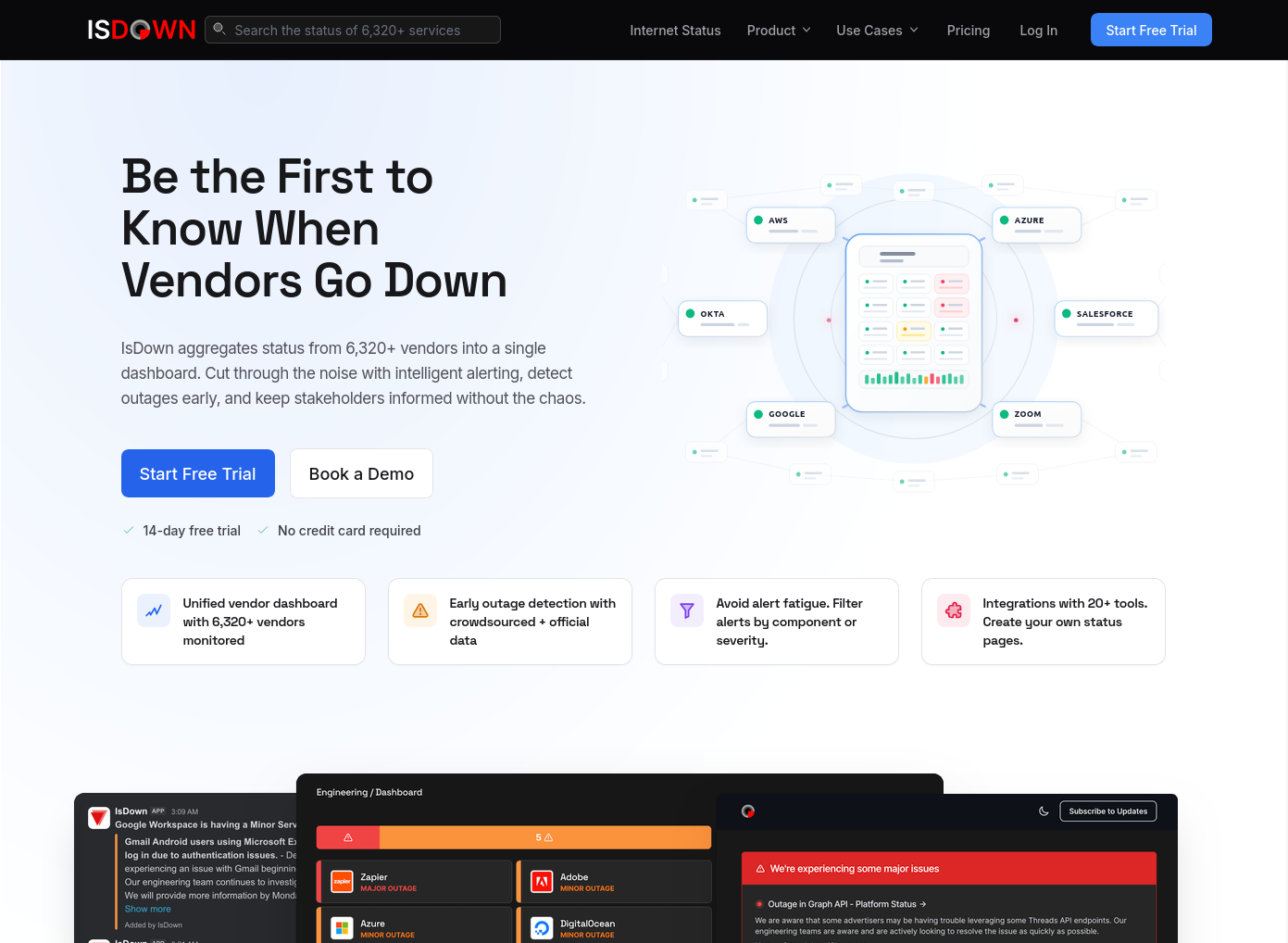
Screenshot: IsDown landing page, captured on September 21, 2026.
Features
From the IsDown website, fetched on September 21, 2026:
- Status page aggregation across 6,320+ vendors
- Component filtering and a maintenance feed
- Early outage detection
- Status pages: public, private, and authenticated, with custom domains and branding removal
- Uptime monitoring with SSL and keyword checks, from multiple locations (every 3 minutes; every 1 minute on the Business plan)
- Private status ingestion for Zendesk and Microsoft 365 (Auth0 listed as "Soon")
- Alerts by email, Slack, Microsoft Teams, Google Chat, Discord, and SMS
- Integrations: Datadog, Grafana, Zendesk, Freshservice, ServiceNow, PagerDuty, Opsgenie, FireHydrant, Rootly, Incident.io, Squadcast, Better Stack, StatusHub, Statuspage.io, Zapier, webhooks
- API access and an MCP server
- Multiple admin users, count depending on the plan
- SSO for admin dashboard and for status page access
- Historical data - 6, 12, 24 months depending on the plan
Pricing
Plans: Starter, Pro, Premium, Business, MSP, and Enterprise. 14-day no credit card free trial.
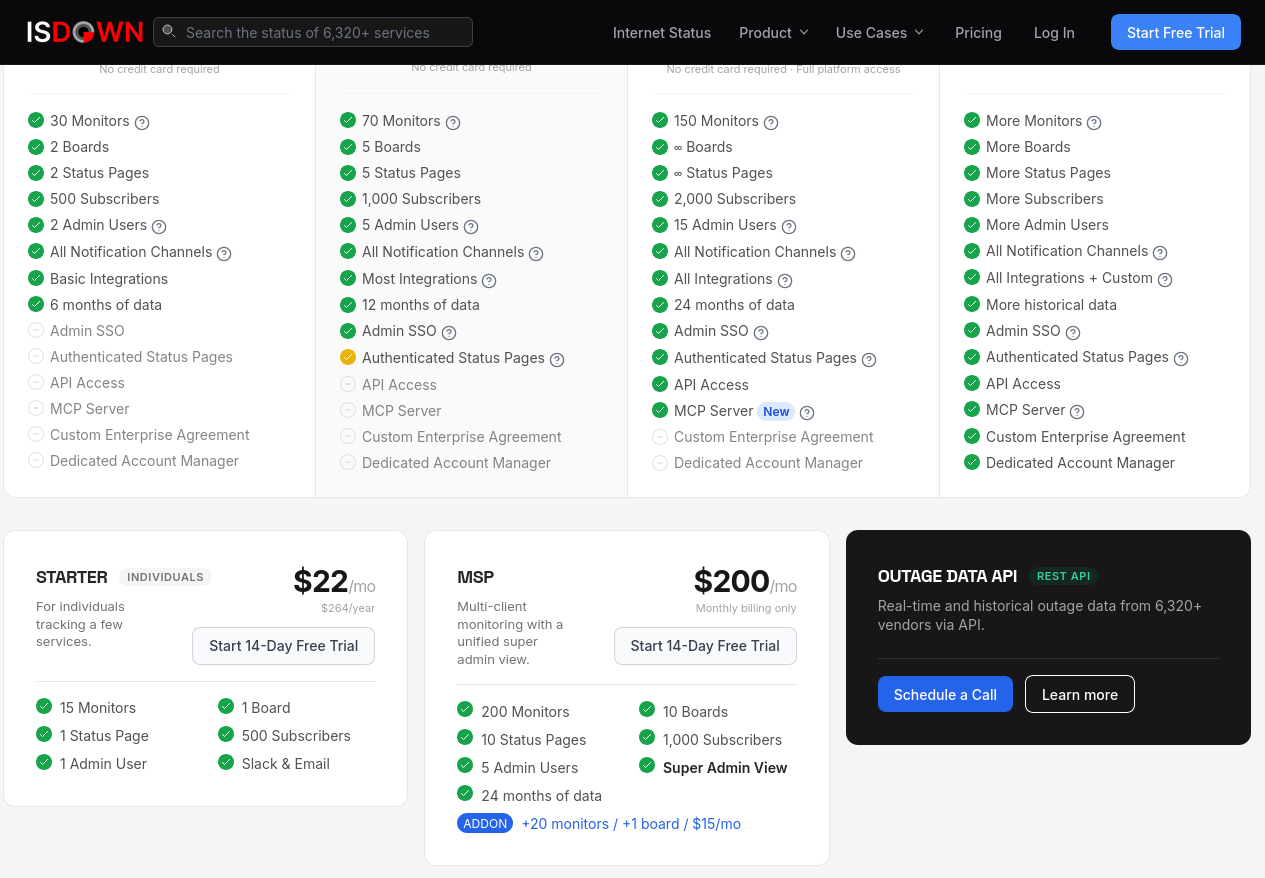
Screenshot: IsDown pricing, captured on September 21, 2026.
IsDown Alternatives
IncidentHub
IncidentHub monitors the official status pages of third-party cloud and SaaS services and sends alerts when a service has an outage.
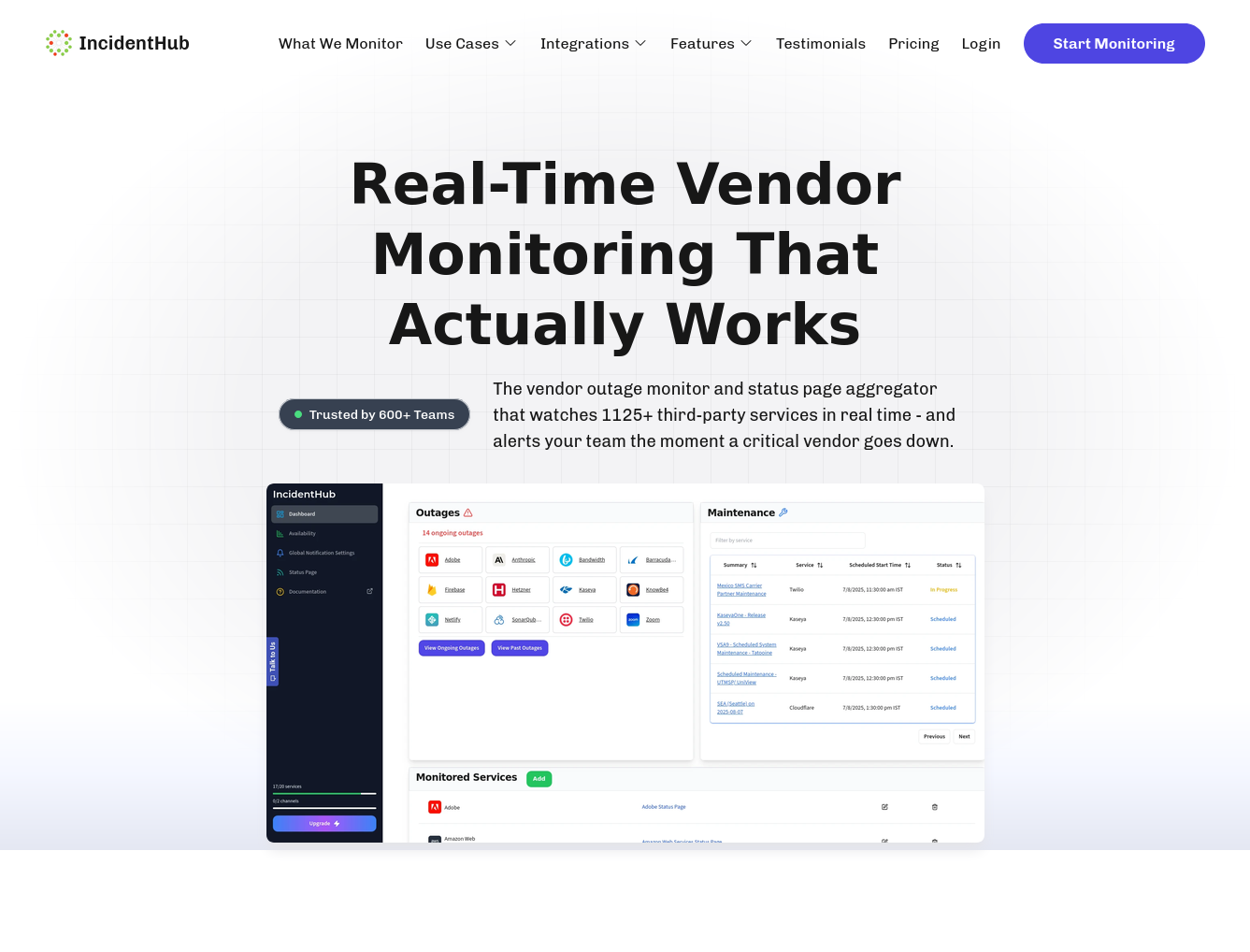
Screenshot: IncidentHub, captured on September 21, 2026.
Features
- 1,125+ services as of this writing
- Unlimited notifications
- Subscribe to individual components, e.g., GitHub Actions rather than all of GitHub
- Turn off maintenance alerts, and choose which alerts in the incident lifecycle to receive (start, updates, and resolution)
- Maintenance feed and maintenance reminders
- Private status ingestion for Microsoft 365, Microsoft Azure, and Infor CloudSuite using official APIs
- Alerts and integrations: Slack, Discord, email, webhooks, Microsoft Teams, PagerDuty, Zendesk, BoldDesk, Freshdesk, and Atlassian Jira Service Management
- Customizable public status page, affected components and history view, password protection, branding removal, and hosting on your own domain
- For MSPs - per-client status pages in a single account: up to 50 on the Multi-Client plan
- Choose which components from each service appear on the public status page as top-level cards (Multi-Client plan)
- Separate teams, each with its own monitors, alerts, and status page to route different alert groups to different alert channels (Business plan)
- Historical availability data and incident timeline per service - 30 and 90 days depending on the plan
IncidentHub monitors fewer vendors than most tools on this list, and that is deliberate. We add a vendor when a customer asks for one, when we target a specific segment, or when we need it for our vendor reliability studies. If a vendor you depend on is missing, tell us and we will add it.
Pricing
Free, Starter, Pro, Multi-Client, Business. 14-day no credit card free trial.
Statusfield
Statusfield tracks the status pages of third-party services and your own sites.
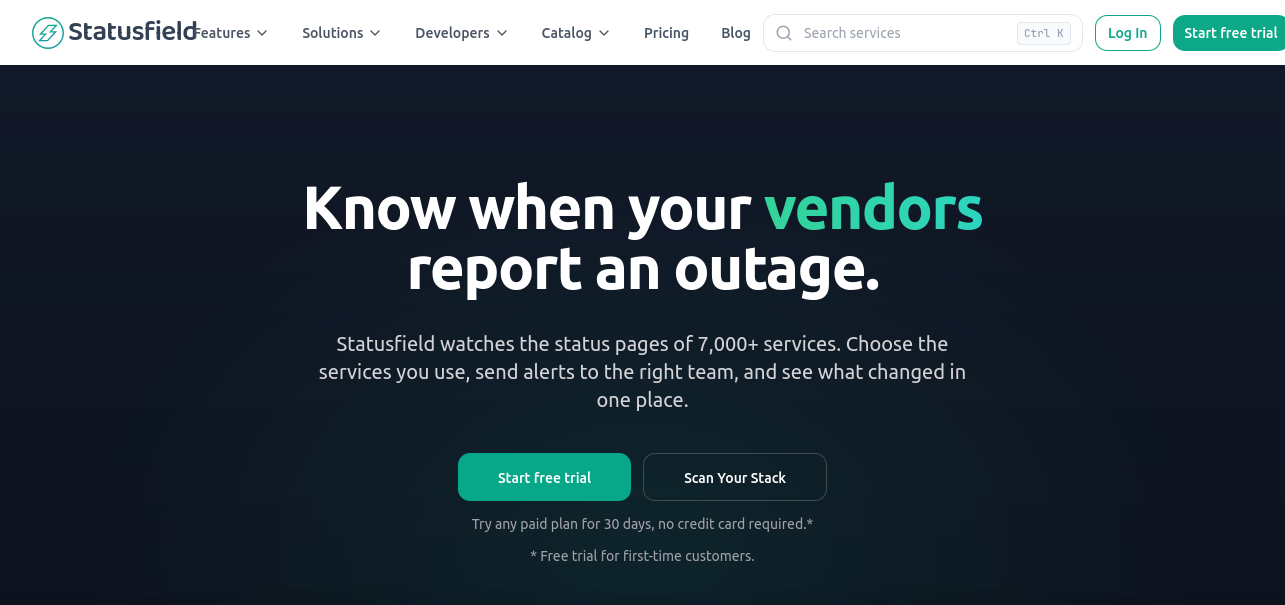
Screenshot: Statusfield, captured on September 21, 2026.
Features
From the Statusfield website, fetched on September 21, 2026:
- 7,000+ services tracked
- Unlimited notifications
- Subscribe to individual components
- Route alerts by severity and type to different alert channels
- Alerts by email, Slack, Microsoft Teams, Discord, Telegram, PagerDuty, Datadog, webhooks
- API, MCP server, and RSS feed
- Uptime, SSL, and domain expiration checks
- Status boards you can share, with password or invite-only access, email subscribers, your logo, and custom URL
- A board per client for MSPs
- Monitoring evidence export for SOC 2 and ISO 27001 audits (Team plan)
Pricing
Basic, Starter, Pro, Team. 30-day no credit card free trial.
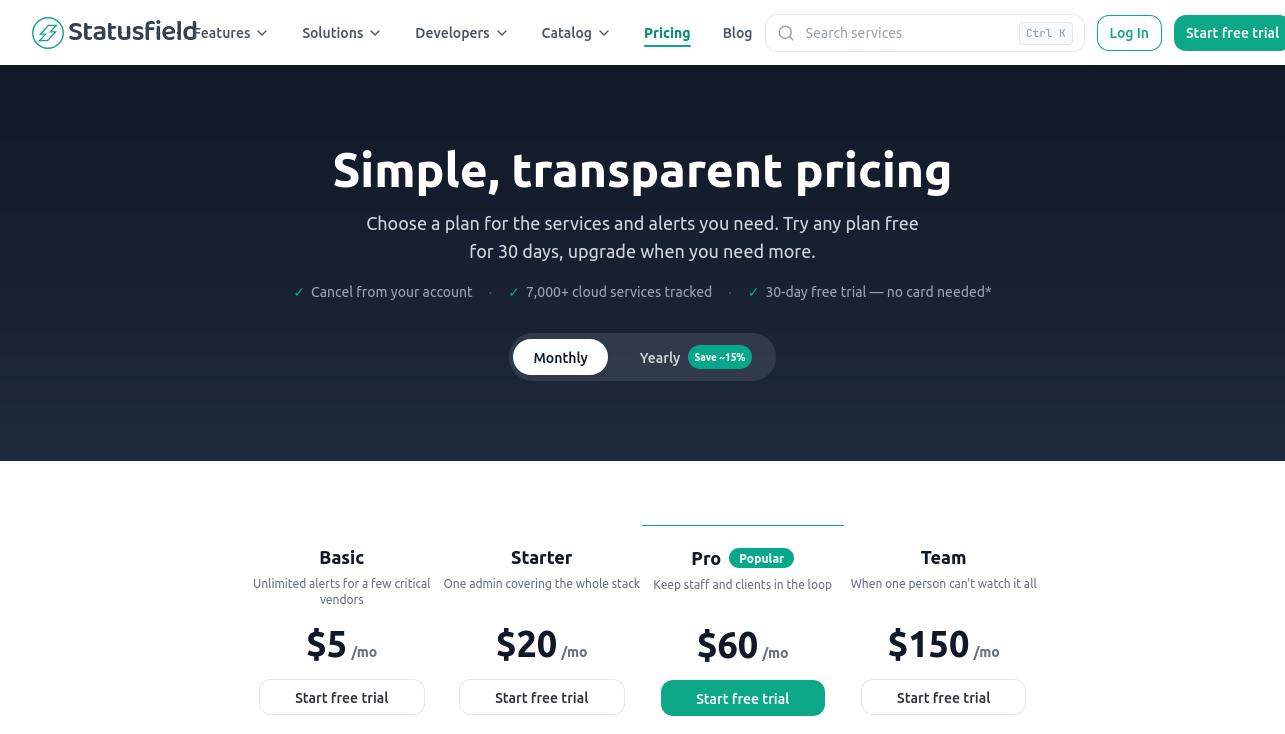
Screenshot: Statusfield pricing, captured on September 21, 2026.
StatusStack
StatusStack monitors third-party services' status in real-time.
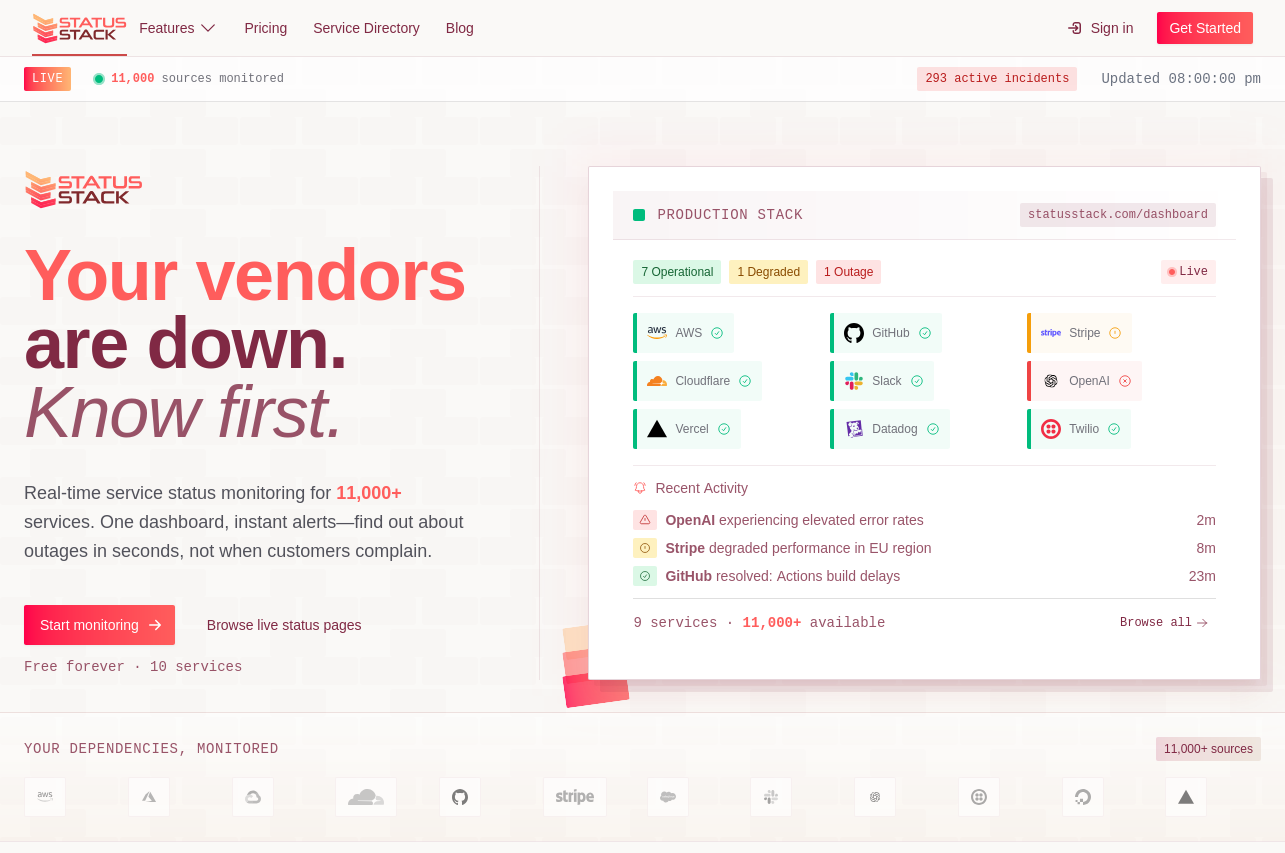
Screenshot: StatusStack, captured on September 21, 2026.
Features
From the StatusStack website, fetched on September 21, 2026:
- 11,000+ monitored sources
- Unlimited team members (Pro plan)
- Website and API monitoring
- Maintenance notifications
- Alerts on email, Slack, Microsoft Teams, webhook, Discord, SMS, Telegram, PagerDuty, Better Stack, Google Chat, Zendesk, Freshdesk, Freshservice, Jira
- Unlimited historical data
- "Stacks": grouped dashboards of the services you choose
- ConnectWise PSA integration (MSP plan)
- Scheduled per-client SLA reports (MSP plan)
- Severity-based, service-specific, and time-based alert routing
- TV board display
- Custom branding, subscriber notifications, custom domains, auth protection for status pages
- Team members and role-based access
Pricing
Free, Pro, MSP. 14-day no credit card free trial.
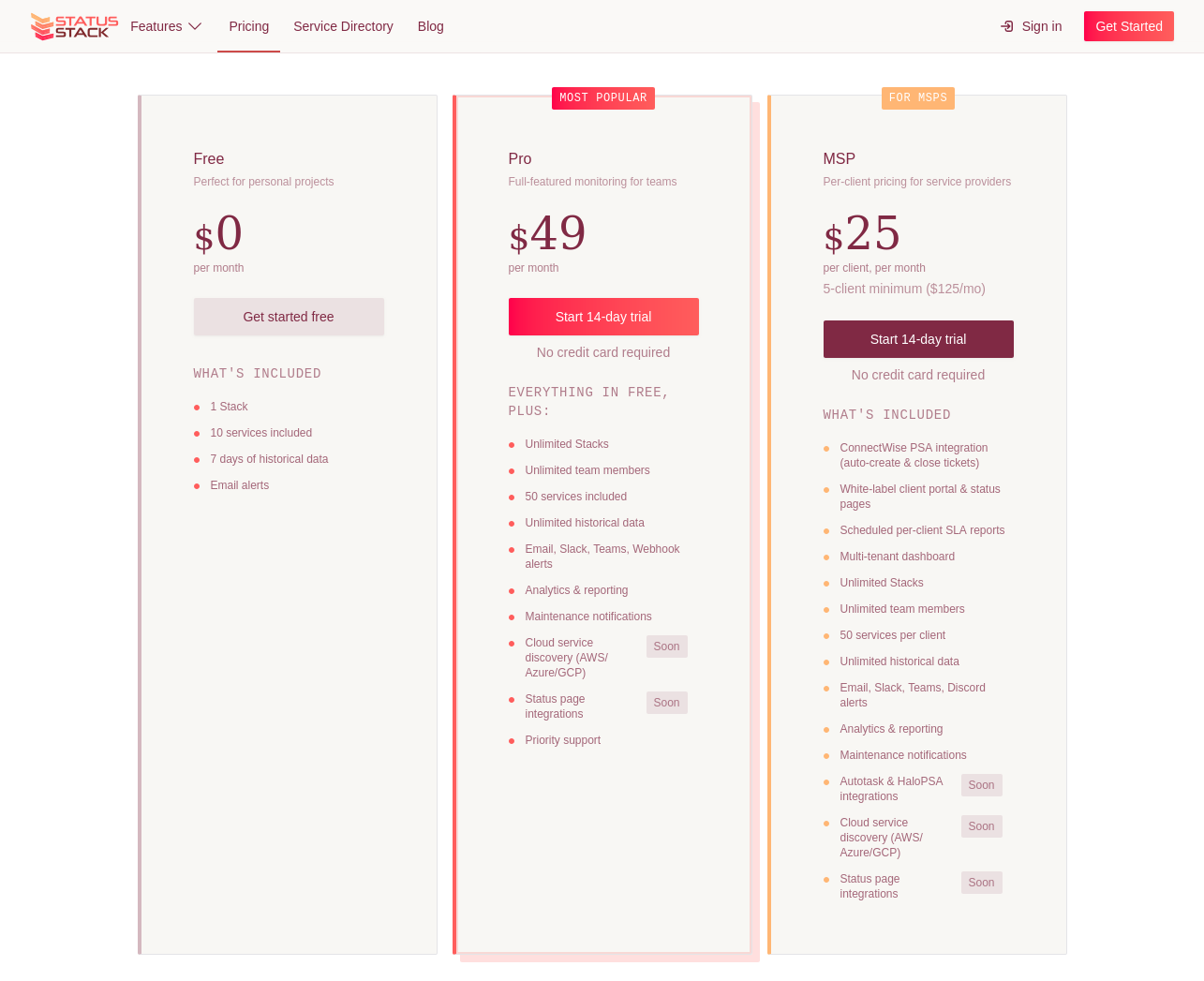
Screenshot: StatusStack pricing, captured on September 21, 2026.
EagleStatus
EagleStatus monitors cloud services from a single dashboard.
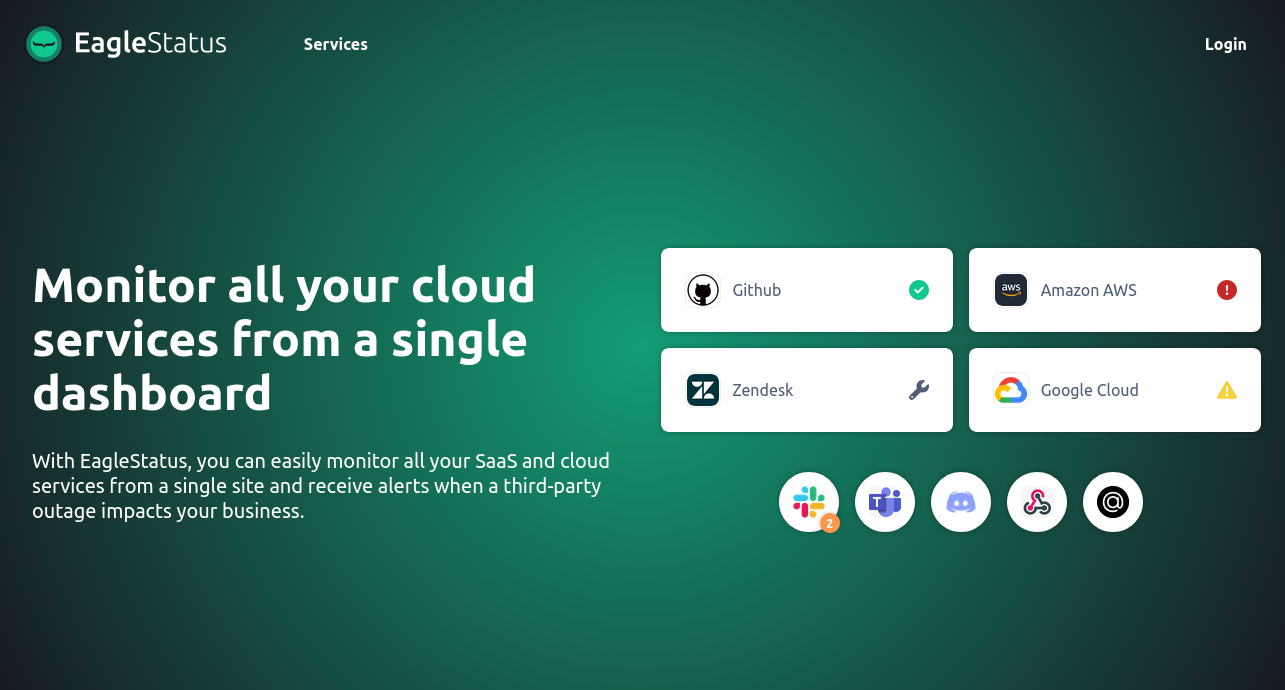
Screenshot: EagleStatus, captured on September 21, 2026.
Features
From the EagleStatus website, fetched on September 21, 2026:
- 1,700+ services
- Multiple dashboards and users on higher plans
- Filtering by component and region
- Alerts on Slack, Discord, Microsoft Teams, webhook, email
- API access, SSO, and custom integrations by contacting their team
Pricing
Free, Basic, Pro, Premium.
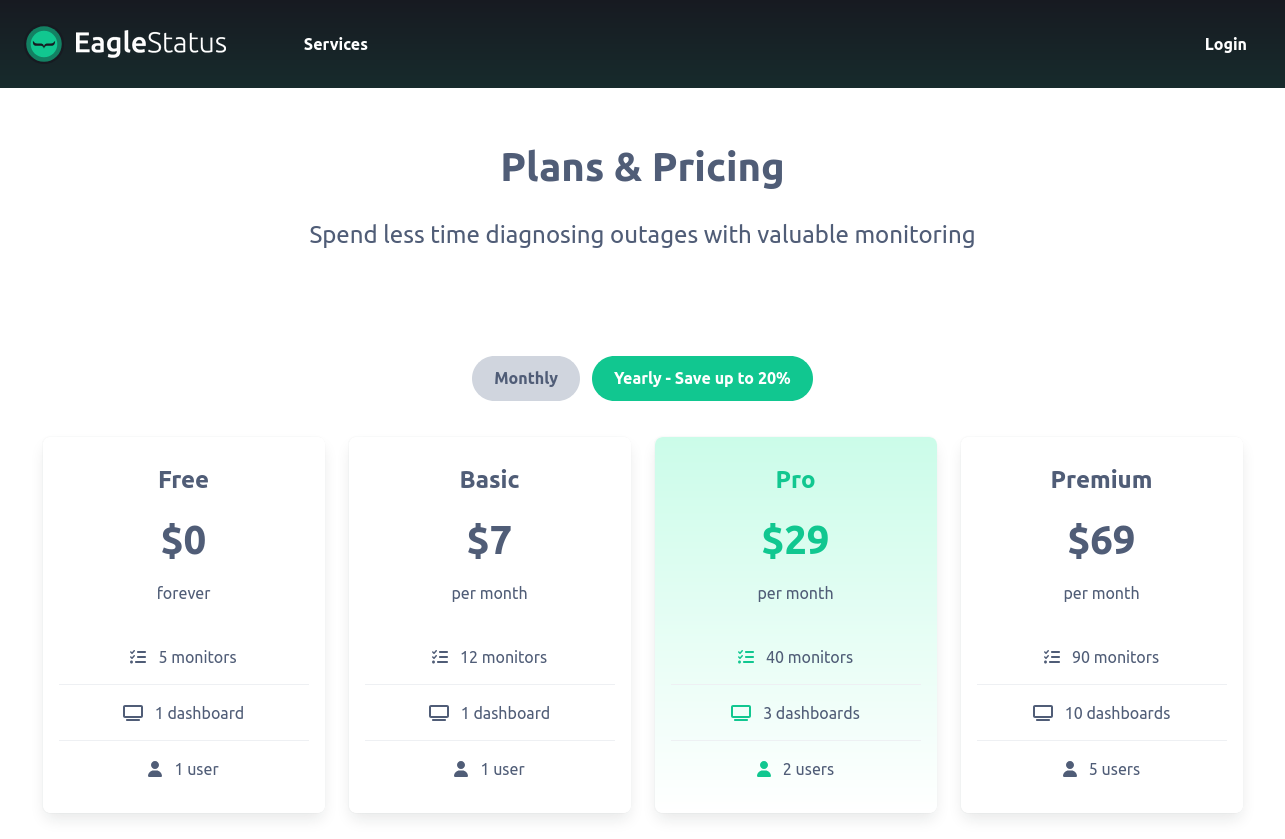
Screenshot: EagleStatus pricing, captured on September 21, 2026.
StatusPulse.io
StatusPulse tracks the operational statuses of critical services and sends you real-time updates of outages and disruptions.
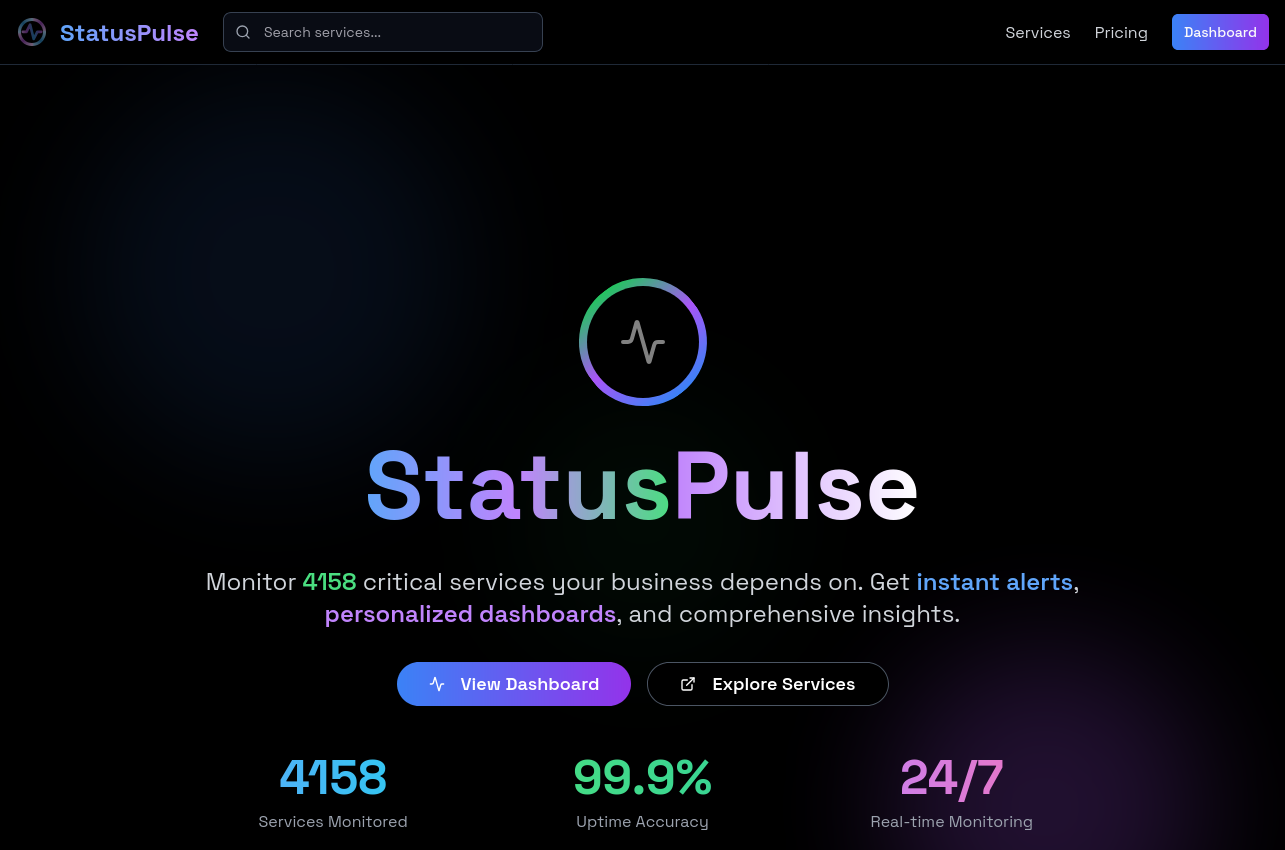
Screenshot: StatusPulse, captured on September 21, 2026.
Features
From the StatusPulse website, fetched on September 21, 2026:
- 4,158 vendors tracked
- Alerts on Slack, Microsoft Teams, Discord, Freshservice, FireHydrant, email
- Service uptime reports
- Uptime and SSL monitoring
Pricing
Free, Starter, Pro, Enterprise.
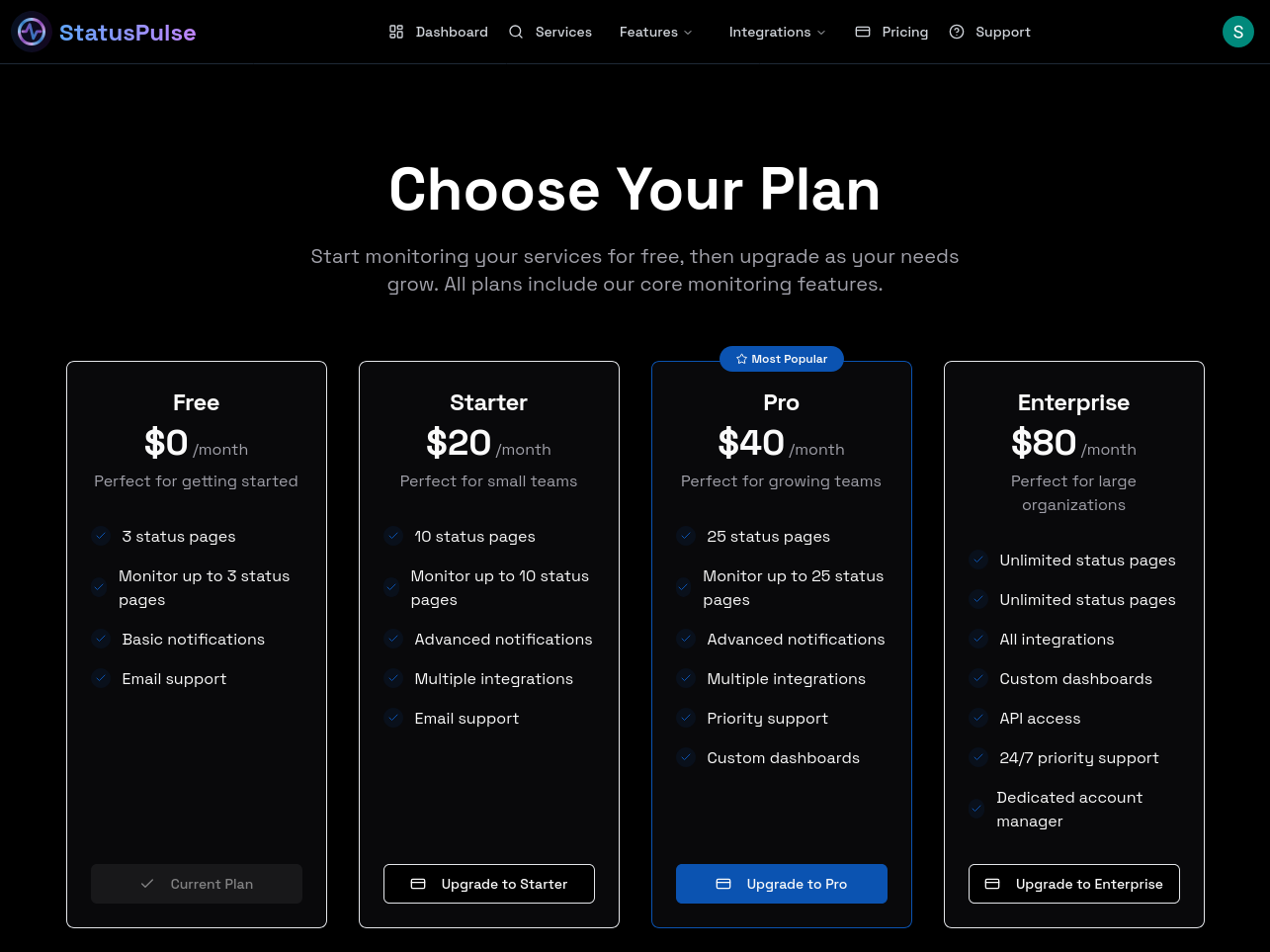
Screenshot: StatusPulse pricing, captured on September 21, 2026.
Outagely
Outagely tracks SaaS vendor outages in one view, for support, IT, and engineering teams.
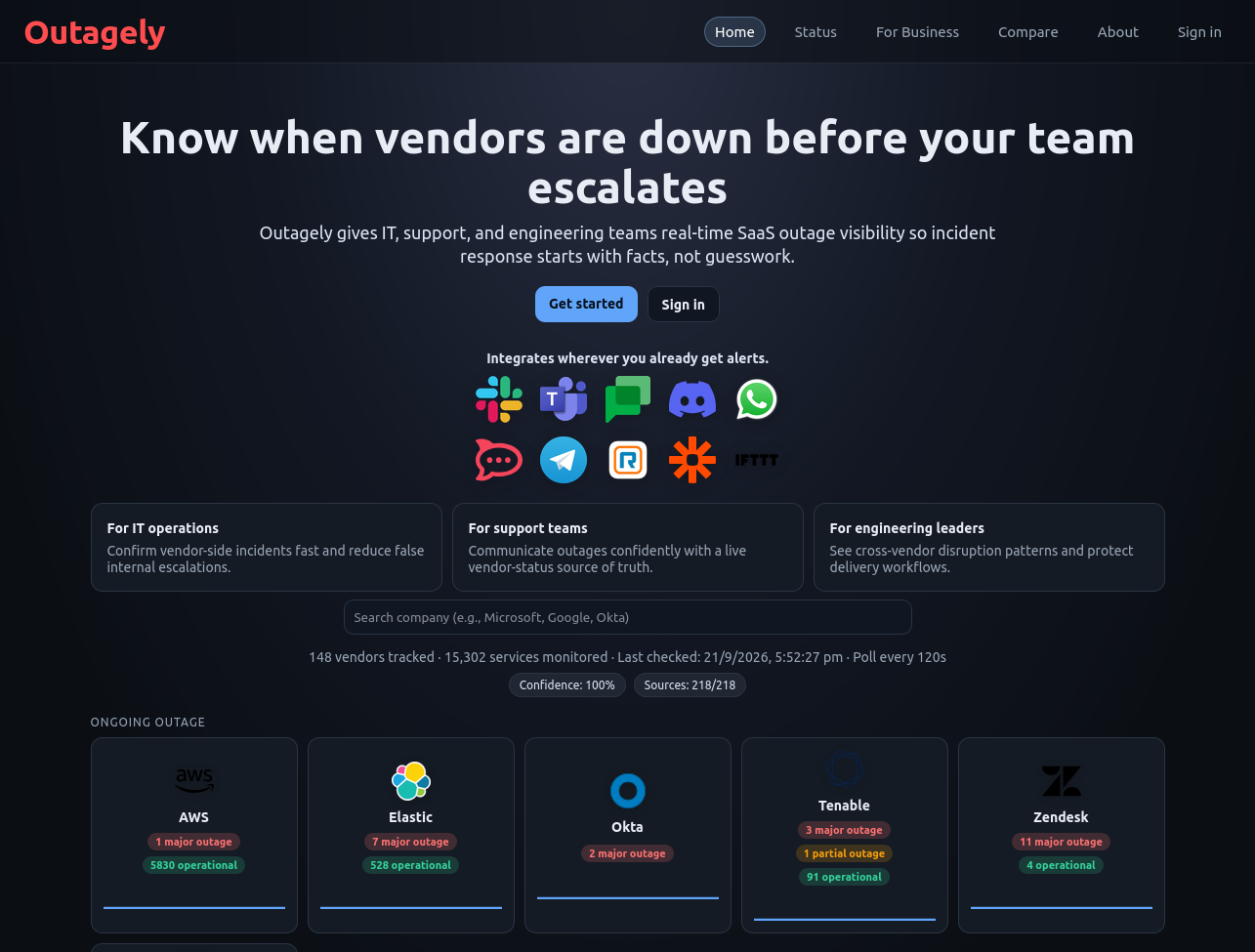
Screenshot: Outagely, captured on September 21, 2026.
Features
From the Outagely website, fetched on September 21, 2026:
- 148 vendors tracked (mentioned on their homepage)
- Alerts on Slack, Microsoft Teams, Google Chat, Discord, Telegram, webhooks
- Service states normalized across vendors
- One dashboard for cloud, SaaS, and platform dependencies
- Incident timeline showing changes and recoveries
- Every entry links back to the vendor's own status page
- Daily briefs and historical patterns for reporting
Pricing
Not published on their website.
Mistakes to Avoid When Switching from IsDown
Switching tools can seem like a small project in itself. However, most of the risk can be in details you only notice after the old tool is gone. Check these before you begin.
Choosing by catalog size
The number of vendors a tool tracks tells you little on its own. What matters is whether the vendors your team depends on are covered, and whether you can pick the components or regions you use, e.g., GitHub Actions rather than all of GitHub. Write down your list and search each tool's catalog for every item on it. If it's not available in the target tool, check with the tool's team how soon they can add it.
Not writing down your current setup
Before you switch, note which vendors you monitor, which components you filter on, and which alerts go to which channel. Rebuilding this from memory in a new tool can lead to missed or noisy alerts, or an incomplete status page.
Checking integrations on the website instead of on your plan
An integrations page lists everything a tool supports. The plan you buy may not include all of it. Check the pricing page for the plan you will actually pay for - the one that will meet all your needs.
Forgetting outages that never reach public status pages
Microsoft 365 and Azure do not post incidents that affect only some tenants on their public status pages. If those matter to you, check whether the tool can read your Microsoft 365 or Azure tenant's service health, and on which plan.
Not deciding how much history you need
If you use past incidents for vendor reviews, SLA claims, or client reports, check how much history the new tool keeps on your plan.
Forgetting custom integrations
If you use any custom integrations with an API or webhooks to build your own dashboards, or to push outage data to your workflows, check whether the new tool can do the same. Even if it does, the data format will likely be different.
Turning everything on at once
Every vendor and every update switched on from day one is a fast way to get the alert channel muted. Start with component filters, decide whether you want maintenance alerts, and add vendors one by one.
Switching before the new tool has seen a real incident
Run the new tool next to your current tool until it has caught at least one real vendor incident, and check that the alert reached the right people. Then go ahead with the switch.
Forgetting your status pages
If staff or clients use a status page from your current tool, that link will change. Set up the new page first, then tell them where it has moved.
Conclusion
The tools above all track vendor outages from one place, but they differ in:
- How many vendors they cover
- Where they send alerts
- Alert routing and filtering critera
- What else they include, e.g., uptime monitoring or per-client status pages
- Which tools they integrate with
- Customizability of status pages
- Tenant-specific health data ingestion
Most of the tools above have a free plan or a free trial, so you can test with your own vendors and existing workflows before you pay.
If you want to try IncidentHub, you can start a 14-day free trial, no credit card needed.
FAQ
Who owns IsDown now?
UptimeRobot, since June 2026, according to IsDown's announcement.
Did IsDown's prices change?
IsDown's announcement said existing customers' plans and prices would stay the same, with billing moving to UptimeRobot.
What is a status page aggregator?
Status page aggregators consolidate outages from many cloud, SaaS, and other third-party services into one unified dashboard or alert channels.
What are common mistakes when switching from IsDown?
Common mistakes when switching can include:
- Choosing by catalog size
- Not writing down your current setup
- Checking integrations on the website instead of on your plan
- Forgetting outages that never reach public status pages
- Not deciding how much history you need
- Forgetting custom integrations
- Turning everything on at once
- Switching before the new tool has seen a real incident
- Forgetting your status pages
IncidentHub is not affiliated with any of the services and vendors mentioned in this article. All logos and company names are trademarks or registered trademarks of their respective holders.
Features and plans were taken from each vendor's own website on September 21, 2026 and may have changed since.
This article was first published on the IncidentHub blog.
You might also like: