The October 20, 2026 Google Cloud europe-west2 Outage


Introduction
Multiple Google Cloud services in europe-west2 (London) experienced service disruptions, elevated error rates, API timeouts and processing latency on October 20, 2026, according to Google's incident page. Google's preliminary incident report records the start at 23:00 US/Pacific on October 19, 2026 (06:00 UTC on October 20) and the end at 05:10 US/Pacific on October 20 (12:10 UTC) - 6 hours 10 minutes. Google attributes the outage to an electrical power interruption at the datacenter facility hosting availability zone europe-west2-b. When UPS batteries depleted after backup generators failed to assume the load, hosts, network hardware and storage in that zone went offline, and failover then overloaded other zones in the region. Google says the preliminary text is its best knowledge at posting and is subject to change, and that a final incident report with preventative actions will follow once the investigation is complete.
- Introduction
- Methodology and Coverage
- Timeline of the Outage
- Impact and Root Cause
- Earlier Google Cloud Outages
- Conclusion
- FAQ
Methodology and Coverage
The sources below were fetched on October 24, 2026.
- Google's incident report page for europe-west2, for the live status updates, the preliminary incident report posted on October 22, 2026, and the affected product list.
- The Guardian (Kalyeena Makortoff and Julia Kollewe, October 20, 2026), for reported impact on Revolut, UK banks, courts and other institutions.
Note: Google's status page timestamps are in US/Pacific. Times in the timeline below are converted to UTC. Live updates during the incident stated the start as 23:08 US/Pacific (06:08 UTC), whereas the preliminary report records customer impact from 23:00 US/Pacific (06:00 UTC) and places the facility power disruption at 22:53 US/Pacific (05:53 UTC). The preliminary report ends the impact window at 05:10 US/Pacific (12:10 UTC); the closure notification on the status page was posted at 07:03 US/Pacific (14:03 UTC).
Timeline of the Outage
Rows without a source tag come from Google's live status updates. Rows tagged [Google preliminary report] come from the preliminary incident report posted on October 22, 2026. Pacific times are converted to UTC.
| UTC | Event |
|---|---|
| Oct 20 05:53 | [Google preliminary report] Electrical power disruption at the datacenter hosting europe-west2-b. PLC fault prevented emergency generators from assuming the load. Facility stayed on UPS. |
| 06:00 | [Google preliminary report] UPS batteries began to deplete, and hosts, storage and network hardware in europe-west2-b lost power. Incident start for customer impact (23:00 US/Pacific, October 19). |
| 06:08 | [Google preliminary report] Automated monitoring alerted Google engineers to elevated API error ratios, job submission timeouts and loss of reachability in europe-west2-b. Live status updates later used this time as the stated start. |
| 08:35 | First public update on the incident page. Multiple services in europe-west2 have elevated errors and intermittent network failures. Engineering is investigating. No workaround. Start stated as 23:08 US/Pacific. |
| 09:24 | Still investigating. Looker Studio noted as not impacted. Workaround: if feasible, migrate the impacted workload to another available zone or region. |
| 11:00 | Status remains as investigating. Looker Studio again noted as not impacted. |
| 11:12 | First live update naming a power event in europe-west2-b. Power event mitigated. Partial mitigation to infrastructure services expected within about 30 minutes. |
| 11:29 | [Google preliminary report] End of the initial phase of elevated errors, API timeouts and processing delays for most Google Cloud services (04:29 US/Pacific). |
| 11:46 | [Google preliminary report] New Compute Engine virtual machine creation resumed (04:46 US/Pacific). |
| 11:58 | Live update: recovery of services in progress with priority on existing workloads. Customers may not yet create new workloads. Full recovery of existing workloads tentatively by 13:00 UTC. |
| 12:10 | [Google preliminary report] Incident end. Over 99% of Compute Engine VMs healthy. Service availability recovered for the vast majority of customer workloads (05:10 US/Pacific). |
| 12:44 | Live update reports recovery for most workloads as of 12:10 UTC. |
| 14:03 | Closure notification: mitigated for most customers. Believed to affect a very small number still. No further live updates. Analysis to follow. |
| Oct 22 08:42 | [Google preliminary report] Preliminary incident report posted (01:42 US/Pacific, October 22). |
Impact window (Google preliminary report): 06:00 UTC to 12:10 UTC on October 20, 2026, 6 h 10 m from Google's stated start to stated end.
The thing to note here is that the first public update on the incident page came about 2 hours 35 minutes after the preliminary report's start, and the live updates first named a power event about 5 hours after that start.
Impact and Root Cause
Google's preliminary incident report, fetched on October 24, 2026, lays out the recovery sequence. Google says the text is its best knowledge at posting and is subject to change, and that a final incident report with preventative actions will be posted once the investigation is complete.
Preliminary Root Cause
A power-grid disruption hit the datacenter facility hosting europe-west2-b. Facility load transferred to UPS battery banks while emergency diesel generators were meant to start. Both the primary and backup programmable logic controllers (PLCs) failed to start or transfer the generators, so the generators never took the load. When UPS reserves ran out, physical hosts, network switching fabric and local storage in europe-west2-b went offline.
From the report, the sequence that followed:
- When the physical host servers, local storage infrastructure, and network aggregation hardware in europe-west2-b lost power, it caused instances, database replicas, and worker nodes in that zone to become immediately unreachable.
- Regional traffic-routing mechanisms and client applications initiated automated failover toward available infrastructure in adjacent availability zones within the region.
- Cross-zone remote procedure calls from regional service control planes directed to metadata and catalog components in the offline zone encountered timeouts, causing initial job submission stalls and API latency spikes.
- The sudden influx of redirected query executions, high-availability database failovers, and compute workloads saturated available compute slots and processing capacity in other availability zones, creating elevated admission queues, delayed database failover completions, and intermittent 500 and 503 API errors across the region.
The physical power loss was limited to europe-west2-b, but the customer impact was not. Google says some customers with workloads in europe-west2-a and europe-west2-c, or across regional architectures, also saw unexpected impact from demand surges on unimpacted capacity and from synchronous control-plane validation dependencies across zonal boundaries.
The End User Experience
According to the preliminary report, customers using Google Cloud services in europe-west2 may have seen service disruptions across two phases lasting 6 hours 10 minutes in total. From 06:00 UTC to 11:29 UTC (5 hours 29 minutes) they may have seen elevated error rates, API timeouts and processing delays until most services recovered. After that, some Compute Engine workloads had a longer recovery tail: new VM creation resumed at 11:46 UTC, and by 12:10 UTC over 99% of Compute Engine VMs were healthy. Workloads and resources hosted entirely in europe-west2-b became unreachable. Multi-zonal and regional services saw elevated latency, transient HTTP 500 and 503 errors, and task admission queuing. Storage write operations in the region had a transient error rate during the initial failover period.
Mid-incident live updates at 09:24 and 11:00 UTC stated that Looker Studio was not impacted; however, the preliminary report's affected-product list includes Looker Studio.
Affected Services
The preliminary report's impact list includes, among others:
- Compute and containers: Google Compute Engine, Google Kubernetes Engine, Google App Engine, Cloud Run, Persistent Disk, Cloud Workstations, VMWare engine
- Networking: Virtual Private Cloud (VPC), Cloud Load Balancing, Cloud NAT, Private Service Connect, Network Connectivity Center
- Data and storage: Google Cloud Storage, Google Cloud SQL, Cloud Spanner, Cloud Firestore, Google Cloud Bigtable, AlloyDB for PostgreSQL, Cloud Filestore, Google Cloud NetApp Volumes, Cloud Memorystore and related Memorystore products
- Data and analytics: Google BigQuery, BigQuery Data Transfer Service, Google Cloud Dataflow, Google Cloud Dataproc, Cloud Data Fusion, Datastream, Looker (Google Cloud core), Looker Studio, Managed Airflow (Google Cloud Composer)
- Messaging, APIs and security: Google Cloud Pub/Sub, Apigee, Managed Service for Apache Kafka, Speech-to-Text, Dialogflow CX, Google SecOps (SIEM and SOAR)
The report also names Regional Persistent Disk among products that saw unexpected degradation in unimpacted zones. Google says data storage services with failover capability such as Cloud SQL, AlloyDB, Memorystore for Redis and Cloud Bigtable failed over into nearby unimpacted zones during the europe-west2-b outage.
The product list in the incident page header is not the same list. That header includes Storage Transfer Service, which the report's impact list does not. The header omits Dialogflow CX, Google SecOps and Looker Studio, which the report does list.
Recovery
Google's preliminary report describes the remediation as traffic isolation away from europe-west2-b, scheduler and capacity adjustments on unimpacted infrastructure, progressive restart of core infrastructure, then gradual traffic re-admission once health and storage integrity were verified. On utility power, the report says on-site facility engineers "conducted graceful restoration of a stable utility power feed once utility supply was back, within 1 hour," then reset and tested the emergency backup generator automation controllers. The report does not say what that one hour is measured from. By 12:10 UTC, availability had recovered for the vast majority of customer workloads. The closure notification at 14:03 UTC still described a very small number of customers as affected.
Confirmed Downstream Impacts
IncidentHub recorded 12 downstream outages which named the Google Cloud europe-west2 outage as a cause.
| Service | Title |
|---|---|
| MoonPay | Revolut Service Disrupted |
| Kinsta | Partial outage in London datacenter |
| StatusCake | Public Reporting Bad Gateway Outage |
| Aiven | Google Cloud VPN incident affecting services |
| Hostinger | Hostinger Dashboard Service API Issue |
| JFrog | JFrog Cloud Platform - Multiple Service Disruptions in GCP Europe West |
| DataStax Astra | GCP europe-west2: Service Degradation |
| Snowflake | Customers hosted in the specified region may be unable to access or use multiple Snowflake services and features, including Snowflake Postgres |
| MongoDB | GCP Availability Zone europe-west2-b connectivity issues |
| Sourcegraph | Sourcegraph Cloud is degraded in Europe region |
| Cloudways | Autonomous: Partial Service Degradation – London Region |
| Stripe | Elevated Revolut Pay errors |
Impact on Revolut and Other UK Institutions
There was widespread impact reported on October 20, 2026 across UK courts and banks. The Guardian attributed that disruption to the Google Cloud failure in europe-west2-b.
The Guardian reported that the video system used for remote court hearings across England and Wales failed to work through the morning, and that several hearings were believed to have been delayed. Revolut said a "service disruption" hit sign-up, sign-in, card payments, transfers, ATM withdrawals and cryptocurrency services, and that customers' money and data remained safe.
By 16:00 UTC (5pm BST), The Guardian reported that most Revolut services on its website were still marked as having problems, with only six of 27 listed services said to be working, including support chat and internal transfers. That is nearly four hours after Google's preliminary report ends the Google Cloud impact window at 12:10 UTC.
Earlier Google Cloud Outages
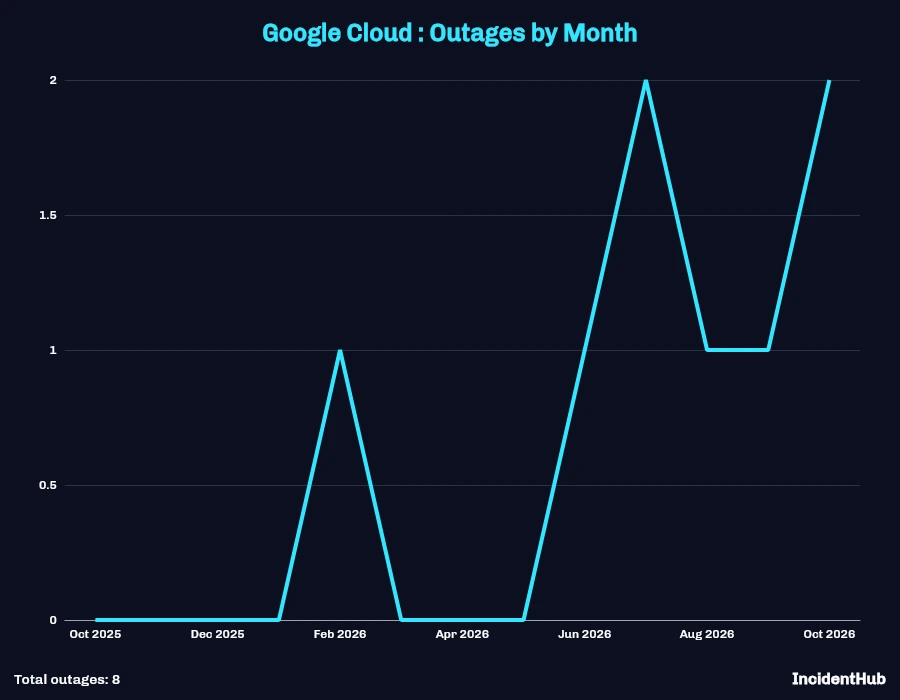
Between October 19, 2025 and October 20, 2026, IncidentHub recorded 8 Google Cloud Platform outages, including this one.
October 8, 2026 - Google Cloud Storage in us-central1
Google Cloud Storage in us-central1 had elevated latency and error rates on uploads and writes from 11:00 UTC to 23:30 UTC on October 8, 2026 - 12 hours 30 minutes - according to Google's incident page. Google's preliminary report attributes the write failures to resource exhaustion on specific backend storage nodes after a traffic sorting optimization, plus a separate metadata database issue for part of the window. That incident was region-scoped to Iowa and was not a power event.
Conclusion
Multiple Google Cloud services in europe-west2 saw disruptions, elevated errors, API timeouts and latency from 06:00 UTC to 12:10 UTC on October 20, 2026 - 6 hours 10 minutes on Google's preliminary report. Google attributes the outage to a power-grid interruption at the facility hosting europe-west2-b, after both primary and backup PLCs failed to start the emergency generators and UPS batteries ran out. Failover saturated other zones in the region. The report remains preliminary; a final incident report with preventative actions is yet to be published at the time of this writing.
FAQ
How long did the October 20, 2026 Google Cloud europe-west2 outage last?
6 hours 10 minutes on Google's preliminary incident report. That report records a start of 23:00 US/Pacific on October 19, 2026 (06:00 UTC on October 20) and an end of 05:10 US/Pacific on October 20 (12:10 UTC). Live updates during the incident stated the start as 23:08 US/Pacific, and the closure notification was posted at 07:03 US/Pacific (14:03 UTC).
What caused it?
A power-grid disruption at the datacenter hosting europe-west2-b, according to Google's preliminary report. Backup generators failed to start because both primary and backup PLCs failed, UPS batteries then depleted, and hosts, network and storage in that zone lost power. Failover and cross-zone control-plane timeouts then caused elevated errors across the region. Google says a final root cause analysis is still underway.
Which region was affected?
London (europe-west2). The physical power outage was isolated to europe-west2-b. Google's preliminary report says some customers in europe-west2-a and europe-west2-c, or on regional architectures, also saw unexpected impact from capacity surges and cross-zone control-plane dependencies.
Was there a workaround?
Yes, while the incident was open. From the 09:24 UTC live update through recovery, Google said that if feasible, impacted customers may try to migrate the impacted workload to another available zone or region.
Did other companies report impact from this incident?
Yes. IncidentHub recorded 12 downstream outages which named the Google Cloud europe-west2 outage as a cause, including MoonPay, Kinsta, StatusCake, Aiven, Hostinger, JFrog, DataStax Astra, Snowflake, MongoDB, Sourcegraph, Cloudways and Stripe.
IncidentHub is not affiliated with any of the services and vendors mentioned in this article. All logos and company names are trademarks or registered trademarks of their respective holders. This summary is independent and not affiliated with or endorsed by Google or any of the services and vendors mentioned in this article.
This article was first published on the IncidentHub blog.
You might also like: