Hrishikesh Barua
Founder, IncidentHub
IncidentHub
View all authors

Product Update - July 2026

· 6 min read
Hrishikesh Barua
Founder, IncidentHub
IncidentHub

What's New in IncidentHub in July 2026?

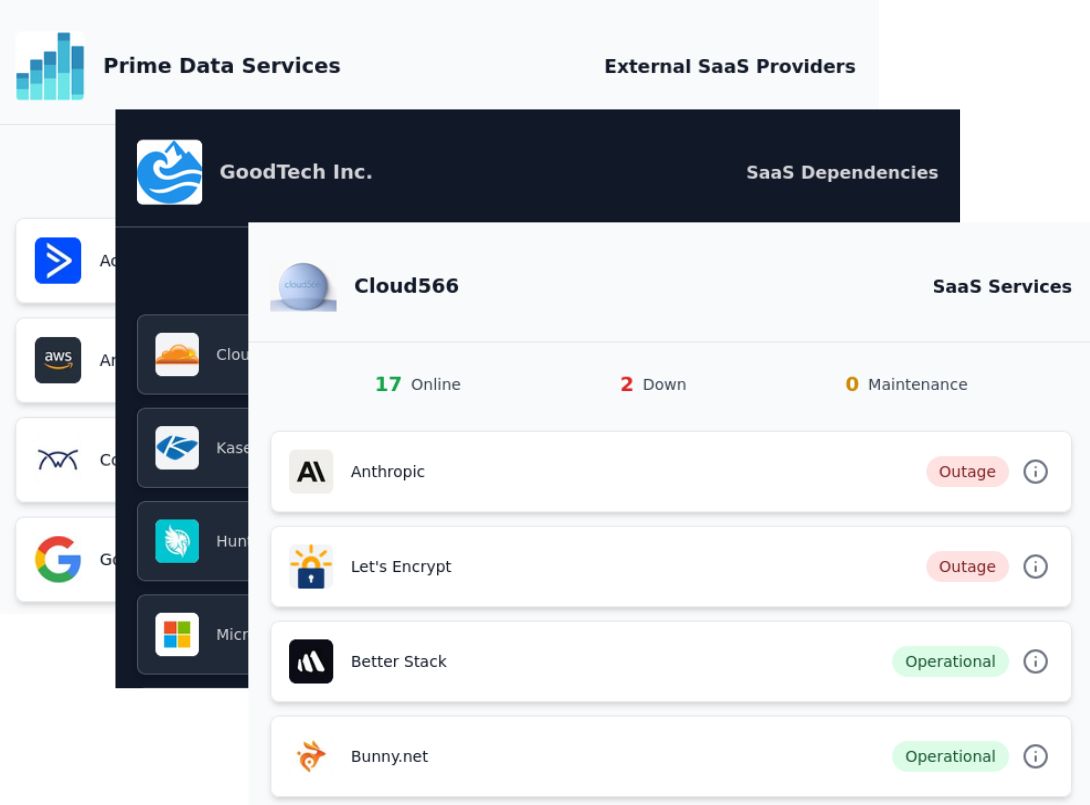
IncidentHub's latest product update includes a Multi-Client plan built specifically for MSPs and agencies with per-client status pages, service components as top-level objects on status pages, and support for more vendors (1125+ and counting).

IncidentHub Product Update - July 2026

The July 24, 2026 AWS us-west-2 Outage: Network Routing and a Long Recovery Tail

· 15 min read
Hrishikesh Barua
Founder, IncidentHub
IncidentHub

Introduction

On July 24, 2026, AWS lost connectivity between the us-west-2 (Oregon) region and the Seattle Metro. The initial impact window was 20 minutes for most and 1 hour 17 minutes for a few customers using AWS Direct Connect through EqSe2, Westin Building Exchange, Seattle. Any traffic that both started and ended inside the region kept working, whereas anything crossing the region boundary saw timeouts and errors. This included the AWS Management Console for some customers.

Downstream services took longer to recover. IncidentHub recorded 9 confirmed cascade incidents across 7 providers, and 3 possible cascade events at 3 more.

AWS us-west-2 Outage July 24, 2026

The July 23 2026 Azure West US Outage: IP Route Removal and Downstream Impact

· 10 min read
Hrishikesh Barua
Founder, IncidentHub
IncidentHub

Introduction

On July 23, 2026, Microsoft Azure experienced a connectivity outage in the West US region that blocked traffic entering or leaving the region for nearly five hours. Workloads that stayed entirely inside West US were not affected. Microsoft's preliminary Post Incident Review (PIR) attributes the failure to a bug in maintenance request conversion software that removed IP routes from more devices than intended during routine device maintenance.

IncidentHub detected a wave of downstream SaaS outages tied to the Azure incident. Acknowledgement times on those status pages varied widely - from a few minutes to more than three hours after Azure's impact began.

IncidentHub's Azure West US Outage 23 July 2026

H1 2026 Cloud and SaaS Reliability Report

· 43 min read
Hrishikesh Barua
Founder, IncidentHub
IncidentHub

Introduction

The first half of 2026 reinforced a key idea about Cloud and SaaS reliability - dependency risk. IncidentHub tracked 30,246 outages across 1,082 providers between January and June 2026. May was the busiest month, with 6,070 incidents. Cloud providers led in the total number of outages (4,723), followed closely by developer tools (4,589).

Besides volume, AI providers moved firmly into the production infrastructure layer with LLM outages resulting in disruption across EdTech, developer tooling, customer support, and communication tools. Automation created new failure modes of its own: Google Cloud's May suspension of Railway's account resulted in almost all their workloads being unavailable. Edge and CDN incidents kept multiplying downstream, IAM remained a login bottleneck for entire product stacks, and Canvas's May security incident took classrooms offline during exam season.

This report breaks down H1 2026 by layer - cloud, edge and DNS, IAM, developer tools, collaboration, AI, payments, observability, and EdTech - with the major incidents, category trends, and cascade patterns based on the data.

H1 2026 Cloud and SaaS Reliability Report - IncidentHub

The July 2026 AWS CloudFront Outage: VPC Origins, Cascade Impact, and What Broke

· 9 min read
Hrishikesh Barua
Founder, IncidentHub
IncidentHub

Introduction

On July 16, 2026, AWS experienced a disruption in its CloudFront service, which affected a large number of websites and applications. The outage was caused by a configuration loading failure in CloudFront's VPC Origins feature. This was AWS's most widely-felt outage after last year's outage on October 20th, which caused widespread damage.

IncidentHub's AWS CloudFront Outage 16 July 2026

Vendor Outage Monitoring for MSPs: Per-Client Status Pages and Custom Dashboards

· 14 min read
Hrishikesh Barua
Founder, IncidentHub
IncidentHub

Introduction

Handling client calls when a third-party vendor has an outage - this will sound familiar if you are a managed service provider (MSP). Your first instinct would be to check if the vendor's status page or social media handle shows anything, or check crowdsourced websites like Downdetector. Or even ask your client to check themselves.

These approaches do not scale when you have more than a few clients, many vendor status pages to check, and clients with different stacks. Public status pages do not always show your client specific issues (e.g. Microsoft 365, Microsoft Azure). Crowdsourced websites can have false positives, and you are delegating something that you should have handled yourself to a third-party website.

This article is about two different strategies you can use to close the gap. Both give your clients an automatically updated status view of the third-party SaaS and Cloud services they depend on, with data gathered from official sources, under your brand. One is a hosted, white-labeled status page you switch on and never have to build. The other is a dashboard you build yourself on top of a live data feed. Which one fits your situation depends on whether you have developers and what you've already got running.

Vendor Outage Monitoring for MSPs

Product Update - June 2026

· 6 min read
Hrishikesh Barua
Founder, IncidentHub
IncidentHub

What's New in IncidentHub in June 2026?

IncidentHub's latest product update includes private status ingestion for Microsoft Azure and Microsoft 365, a simpler UI for alerts configuration, an option to disable the public status page, and a better looking status page layout. Plus, support for more vendors (1070+ and counting).

As always, I am grateful to all our customers and beta testers who have shared their feedback which has made IncidentHub better.

IncidentHub Product Update - June 2026

Product Update - May 2026

· 8 min read
Hrishikesh Barua
Founder, IncidentHub
IncidentHub

What's New in IncidentHub in May 2026?

IncidentHub's latest product updates include a new Business plan with Teams support, early outage detection v1, and more integrations with ticketing systems. The public status now includes a disable feature. As before, many features are driven by feedback, and I am grateful to all our customers who have shared their feedback with us.

IncidentHub Product Update - May 2026

GitHub Outages 2025 - 2026: Reliability Analysis and Outage History

· 26 min read
Hrishikesh Barua
Founder, IncidentHub
IncidentHub

Executive Summary

Hashicorp's co-founder Mitchell Hashimoto decided to pull out his Ghostty project from GitHub in April 2026 due to GitHub's reliability issues. He did this after 18 years of using GitHub, saying that GitHub "is no longer a place for serious work".

GitHub has experienced a significant decline in reliability over the past 6 months, and Hashimoto is not alone in expressing this sentiment. In the past 12 months, GitHub has experienced 48 major outages, including outages in GitHub Actions, Copilot, Pull Requests, and core Git operations.

This article analyzes in depth GitHub's outage history between May 2025 and April 2026, the possible causes, and the impact on developers and businesses. IncidentHub has monitored every GitHub outage for the past 12 months and beyond - read on to find out what the data reveals.

IncidentHub's GitHub Reliability and Outage History Report banner

Why IncidentHub's Alerting is Better than Other Status Page Aggregators'

· 23 min read
Hrishikesh Barua
Founder, IncidentHub
IncidentHub

The Alert Fatigue Problem in SaaS Dependent Teams

IncidentHub tracked 48000 SaaS and Cloud outages in 2025. The average organization depends on 100+ SaaS apps, making third-party vendor monitoring a crucial aspect of risk management and business continuity for almost all modern organizations.

Better SaaS outage alerting is about monitoring the right parts of your third-party services, and routing alerts to the right people at the right time.

This article covers the six criteria that separate useful cloud outage alerts from noisy ones, how IncidentHub's alerting works, real-world scenarios where it matters, and who this tool is built for.

IncidentHub's SaaS Outage Alerts

Product Update - March 2026

· 7 min read
Hrishikesh Barua
Founder, IncidentHub
IncidentHub

Introduction

IncidentHub's latest product updates focus on improving the public status page, adding integrations with ticketing systems, private status page ingestion, and making the notifications more useful to the end user. Some of these improvements are driven by user feedback.

Feedback is what makes the product better, and I am personally grateful to all our customers who have shared their feedback with us.

IncidentHub Product Update - March 2026

The Definitive AWS Outage Report 2025: Reliability Analytics and Cascade Impact

· 24 min read
Hrishikesh Barua
Founder, IncidentHub
IncidentHub

Introduction

Amazon Web Services remains one of the most popular cloud providers, with 200+ services in 39 regions across the world. Like all providers, they have their share of outages.

In 2025, IncidentHub detected 38 AWS outages, of which the one on October 20th had the most widespread impact affecting hundreds of SaaS providers simultaneously. Payments were disrupted, students lost access to classrooms, developer tooling degraded, and some IT teams experienced alerting gaps.

In this post we look at the reliability of AWS in 2025 based on their own publicly available status page data aggregated by IncidentHub, with a deeper analysis of the cascading impact of the October 20th outage.

Amazon Web Services Reliability in 2025

How to Monitor SaaS Status in 2026 : A Complete Guide

· 29 min read
Hrishikesh Barua
Founder, IncidentHub
IncidentHub

Introduction

This is an updated and expanded version of the older guide.

According to the 2025 State of SaaS report, organizations use an average of 106 SaaS apps.

Staying on top of your SaaS vendors' status is as important as monitoring your own services. The Cloudflare, AWS, Azure, and Google Cloud outages in 2025 were strong reminders of this fact. As a result of these outages, many SaaS services that depend on them experienced outages as well, leading to a cascading effect which took down hundreds of vendors and affected thousands of users. Cloud and SaaS outages are not isolated any longer but usually happen in groups due to the dependency chain.

This article aims to be a comprehensive guide on how to monitor the uptime status of your SaaS and Cloud vendors.

Monitoring SaaS Status in 2026 - A Complete Guide

Major Cloud Outages of 2025

· 11 min read
Hrishikesh Barua
Founder, IncidentHub
IncidentHub

Cloud Outages and Their Impact

Cloud outages in 2025 ranged from minor ones affecting some sections of users, to major ones affecting hundreds or thousands of users. Services like Cloudflare and AWS on which many other services depend experienced outages that affected many due to the cascading effect.

Let's look at some of the major cloud outages in 2025.

Major Cloud Outages in 2025

How to Receive Cloud Outage Alerts in Microsoft Teams

· 6 min read
Hrishikesh Barua
Founder, IncidentHub
IncidentHub

The Impact of Cloud Outages on Your Business

Cloud outages like the recent ones at Cloudflare, Microsoft Azure, and AWS can have a significant impact on your business with downtime, lost revenue, and unhappy customers. They can also disrupt your team's ability to work effectively. To stay on top of such outages, your team needs to know about them in an easy and timely way.

In this article, we will see how to integrate IncidentHub cloud outage alerts with Microsoft Teams.

How to Receive Cloud Outage Alerts in Microsoft Teams